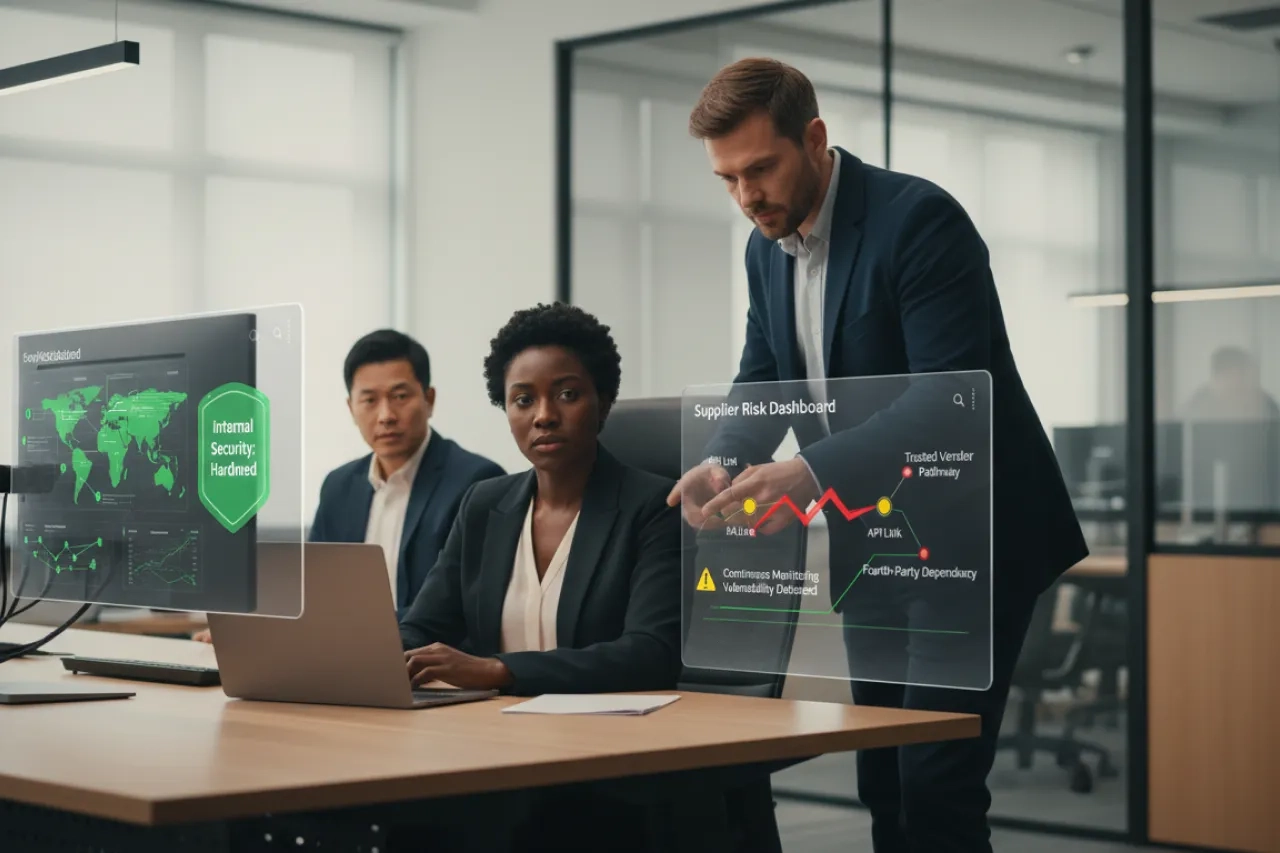
Supplier Cyber: How to Assess Third-Party Cybersecurity Risk

Supplier Cyber: Risk Scoring, ISO Standards & Continuous Monitoring
Supplier cyber risk has become a critical component of modern third-party risk management. As organisations increasingly rely on interconnected digital supply chains, evaluating the cybersecurity maturity of suppliers is essential to protect sensitive data, maintain operational continuity, and comply with regulations such as GDPR, NIS2, and DORA.
Cyber risk is no longer confined to internal systems. In 2024, global cybercrime costs are projected to reach $9.5 trillion, with supply chain attacks becoming one of the fastest-growing threat vectors.
High-profile breaches have demonstrated a simple reality: an organisation’s cybersecurity posture is only as strong as its weakest supplier.
For procurement, risk, and IT leaders, supplier cybersecurity assessment has become a core pillar of third-party risk management (TPRM) and operational resilience.
The average cost of a data breach now exceeds $4.88 million per incident, making structured supplier evaluation not just a compliance exercise, but a financial necessity.
Why Supplier Cybersecurity Assessment Is Strategic ?
Modern supply chains are digital ecosystems. Suppliers often have API integrations, cloud access, data processing responsibilities, and remote support connectivity. Each connection creates a potential attack surface.
A structured supplier cybersecurity assessment enables organisations to identify third-party vulnerabilities, prioritise critical supplier risk, align with ISO, GDPR, and sector regulations, and strengthen business continuity.
Cybersecurity due diligence must now be continuous, risk-based, and auditable.
Key Criteria for an Effective Supplier Cybersecurity Assessment
1. Cybersecurity Audit and Maturity Evaluation
A robust assessment begins with a structured cybersecurity audit.
Key evaluation domains include:
Protection Measures
This covers network security architecture, access control policies, data encryption standards, and cloud security configurations.
Incident Management
Organisations should verify documented incident response procedures, dedicated cybersecurity governance, and tested disaster recovery and business continuity plans.
Compliance Alignment
Suppliers should demonstrate ISO 27001 certification, ISO 27701 for privacy management, GDPR compliance mechanisms, and documented security policy updates.
A maturity-based approach evaluates not only control existence, but operational effectiveness.
2. Certifications and Regulatory Compliance
Recognised certifications signal structured security governance.
ISO 27001 demonstrates an information security management system aligned with international standards.
ISO 27701 extends this framework to privacy protection.
Supplier compliance with regulations such as GDPR reduces legal exposure, regulatory penalties, and contractual liability.
Certification alone is insufficient. Ongoing monitoring and evidence validation are required.
3. Cybersecurity Maturity Indicators
Cybersecurity maturity reflects how deeply security practices are embedded in daily operations.
Key indicators include dedicated security leadership, regular employee awareness training, privileged access management, vulnerability management processes, and continuous monitoring tools.
Mature suppliers reduce systemic exposure across the value chain.
Managing Third-Party Cyber Risk Holistically
Supplier cybersecurity assessment must integrate into a broader third-party risk framework.
Risk Scoring and Prioritisation
Not all suppliers carry equal exposure.
Risk scoring models should assess financial stability, operational dependency, cybersecurity posture, regulatory exposure, and reputational impact.
Critical suppliers require enhanced due diligence and continuous monitoring.
Access Control Governance
Third-party access is one of the most common breach vectors.
Best practices include the least privilege principle, multi-factor authentication (MFA), network segmentation, time-bound privileged access, and continuous access review.
Zero-trust architecture principles should extend to supplier relationships.
Business Continuity and Cyber Resilience
Cyber resilience is not only about prevention. It is about recovery.
Suppliers must demonstrate tested disaster recovery plans, defined recovery time objectives (RTOs), data backup and restoration capability, and incident notification procedures.
A supplier without business continuity planning represents systemic operational risk.
Strengthening Supplier Cybersecurity with ISO 27001 and 27701
ISO-aligned supplier ecosystems reduce aggregate exposure.
A structured ISO framework ensures documented risk assessment, continuous improvement cycles, defined governance responsibilities, and measurable control effectiveness.
Organisations that embed ISO-based supplier assessment into procurement workflows create defensible, audit-ready risk programmes.
Supporting Supplier Maturity Improvement
Some suppliers lack full certification but show improvement potential.
Structured improvement programmes may include pre-certification audits, gap analysis reports, action roadmaps, targeted remediation guidance, and monitoring checkpoints.
Elevating supplier maturity strengthens the entire supply chain.
Building a Security-First Supply Chain Culture
Supplier cybersecurity governance must go beyond questionnaires.
Sustainable security requires continuous awareness programmes, sector best-practice sharing, collaborative remediation efforts, and transparent communication channels.
Organisations that foster collaborative security partnerships outperform those relying solely on contractual enforcement.
From Reactive Compliance to Proactive Risk Governance
Supplier cybersecurity assessment is no longer optional.
It enables organisations to reduce breach probability, protect sensitive data, ensure regulatory compliance, maintain operational continuity, and strengthen investor confidence.
The future of third-party cybersecurity management is continuous, automated, risk-based, and integrated across departments.
Centralising Third-Party Cyber Risk with Aprovall
Aprovall provides a European TPGRC platform enabling organisations to centralise supplier cybersecurity documentation, automate risk scoring and reassessments, monitor compliance across ISO, GDPR, ESG, and financial domains, trigger remediation workflows, and maintain audit-ready evidence trails.
Strengthen your third-party cyber resilience with structured, proportionate governance.
Explore how Aprovall can support your supplier cybersecurity strategy.
Conclusion
Supplier cybersecurity assessment has evolved from a compliance checkbox into a strategic imperative for organisational resilience. In a threat landscape where cyberattacks occur every 11 seconds and supply chain breaches regularly compromise millions of records, the security posture of third-party partners directly impacts business continuity, regulatory standing, and stakeholder trust.
A structured, risk-based approach – grounded in international standards such as ISO 27001 and ISO 27701 – enables organisations to identify vulnerabilities across their supplier ecosystem, prioritise critical exposures, and build defensible governance frameworks. Combined with continuous monitoring, dynamic risk scoring, and collaborative maturity programmes, this approach transforms supplier cybersecurity from a periodic exercise into an integrated, proactive capability.
Organisations that embed cybersecurity assessment into their broader third-party risk management strategy will not only reduce breach probability and regulatory exposure, but also strengthen the trust and resilience that underpin long-term partnerships. In a world of escalating digital interdependence, proactive supplier cybersecurity governance is no longer optional – it is a competitive advantage.
Book a meeting at our booth
Don’t miss this opportunity to connect with our team, see our solutions in action, and discuss how Aprovall can help you drive procurement excellence and stronger supplier risk management.
You have question ?
We have answer.
A supplier cybersecurity assessment is a structured evaluation of a third party’s information security posture. It examines technical controls, governance frameworks, certifications (such as ISO 27001), incident response capabilities, and regulatory compliance.
Its objective is to determine whether a supplier introduces unacceptable cyber risk to your organisation.
Modern organisations routinely share sensitive data, critical systems, and operational infrastructure with external partners. This interconnectedness means that a single compromised supplier can serve as an entry point for ransomware attacks, large-scale data breaches, or prolonged operational disruption. As a result, effective third-party risk management (TPRM) must integrate structured cybersecurity assessments as a core component, enabling organisations to reduce systemic exposure and strengthen resilience across the entire supply chain.
Frequency depends on risk tiering. Critical suppliers should be reassessed quarterly or through continuous monitoring, high-risk suppliers require annual reassessment, and low-risk suppliers benefit from periodic review. Continuous external monitoring is recommended to detect emerging cyber threats between formal assessments.
Several internationally recognised standards should guide a supplier cybersecurity evaluation:
- ISO 27001 – Information Security Management
- ISO 27701 – Privacy Information Management
- GDPR – Data protection compliance requirements
- NIS2 or DORA – Digital resilience for regulated sectors in Europe
Assessment frameworks should align with your organisation’s regulatory exposure and sector-specific requirements.
ISO 27001 certification is a strong indicator of structured security governance. However, certification alone does not eliminate risk.
Organisations should verify scope coverage, audit recency, and operational maturity, and combine certification review with risk-based monitoring.
An effective supplier cyber audit should evaluate:
- Access control mechanisms, including least privilege and multi-factor authentication (MFA)
- Data protection and encryption practices
- Incident response procedures and governance
- Business continuity and disaster recovery plans
- Vulnerability management processes
The goal is to assess operational effectiveness, not just the existence of documentation.
Effective risk prioritisation requires a multidimensional approach that evaluates how much sensitive data a supplier handles, how deeply integrated their systems are with yours, the degree to which your operations depend on them, their financial stability, and the regulatory consequences of a potential incident. By applying a tiered risk scoring model based on these factors, organisations can concentrate resources on the most critical suppliers and ensure that due diligence efforts are proportionate to actual exposure.
Continuous monitoring detects real-time changes in supplier risk posture, including security rating fluctuations, breach disclosures, expired certifications, adverse media, and sanctions or regulatory actions. It transforms supplier oversight from periodic review to dynamic risk governance.
Suppliers that lack robust recovery capabilities can significantly amplify the impact of a cyber incident across your operations. To mitigate this risk, organisations should assess whether suppliers maintain realistic Recovery Time Objectives (RTOs), conduct regular backup testing, follow clear incident notification procedures, and operate resilient cloud infrastructure. Ultimately, business continuity planning at the supplier level is just as critical as preventive security controls.
A dedicated third-party risk management platform brings together supplier documentation, cybersecurity assessments, risk scoring, monitoring alerts, and remediation workflows into a single integrated environment. By automating routine processes such as reassessment scheduling and compliance tracking, these platforms reduce administrative burden while significantly improving audit readiness and regulatory compliance. They also enable procurement, IT, legal, and risk teams to collaborate more effectively, ensuring that supplier cyber resilience is managed as a shared organisational priority rather than a siloed function.
-
 27 February 2026Supplier risk: how IT leaders drive organisation-wide risk reductionCyberSupplier risk: why it’s now a CIO-level resilience priority Supplier risk : the SolarWinds breach proved that enterprise security depends on third parties. For CIOs, reducing supplier risk is no longer a procurement checklist—it’s core to resilience, cybersecurity governance and regulatory compliance, at scale. For CIOs and IT leaders, supplier risk management is no longer […]
Read more
-
 11 March 2026ThirdParty Cyber: Assess Supplier Security Without On-Site AuditsCyberThirdParty Cyber: Remote Assessment, Evidence & Continuous Monitoring ThirdParty cyber risk has become a central element of operational resilience. As supplier ecosystems expand, organisations must evaluate cybersecurity maturity across hundreds of partners without relying on resource-intensive on-site audits. A structured remote methodology—combining vendor tiering, digital evidence collection, external security ratings, and continuous monitoring—enables rigorous assessments […]
Read more
-
 18 March 2026NIS2 Suppliers: What the Directive Changes for Vendor Risk ManagementCyberNIS2 Suppliers: Due Diligence, Monitoring & Incident Accountability NIS2 suppliers obligations redefine how organisations manage vendor cybersecurity risk. Under the directive, companies are accountable not only for their internal security posture but also for the resilience of suppliers and service providers supporting critical operations. This makes structured supplier risk management and continuous oversight essential for […]
Read more
-
 27 March 2026Third-Party Cybersecurity: The Weakest Link in Enterprise SecurityCyberThird-Party Cybersecurity: Managing Vendor Risk & Supply Chain Attacks Third-party cybersecurity has become the most exploited vulnerability in modern enterprise security strategies. Even with strong internal controls, organisations remain exposed when vendors, suppliers, and service providers operate with weaker security, creating indirect access points that bypass traditional defences. While companies invest heavily in firewalls, endpoint […]
Read more