How TPRM Solutions Help Procurement Teams Cut Administrative Workload by 25%
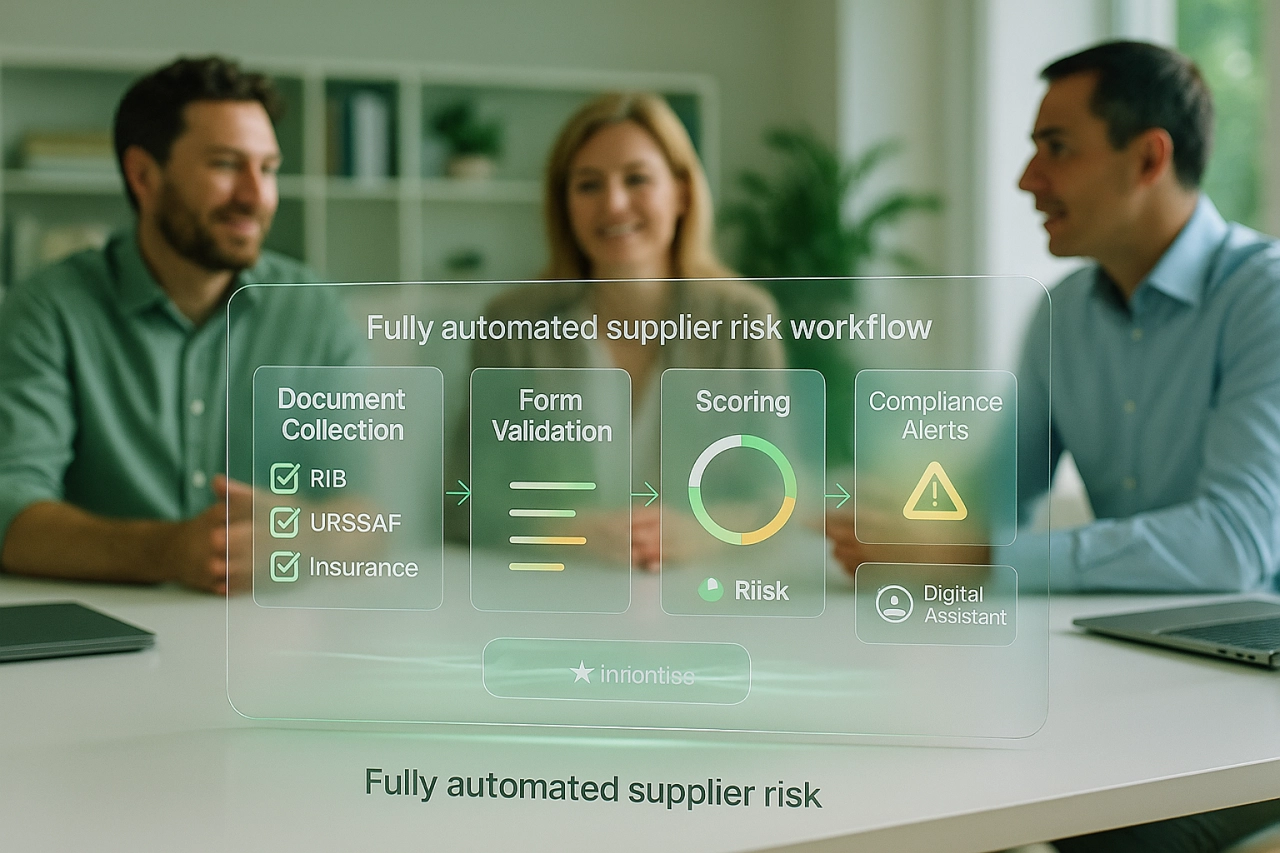
Reducing repetitive administrative tasks is one of the top priorities for Procurement Departments—so teams can focus on strategy, performance, and supplier relationships.
The current landscape only adds pressure. Procurement professionals juggle multiple demands alongside increasing risks: climate, geopolitical, social—not to mention the classic ones: financial, environmental, cybersecurity, and human rights-related.
SRM tools offer a first layer of support, but it’s TPRM platforms that truly ease the daily workload by automating end-to-end supplier risk management.
Today’s Procurement Managers must also address new critical dimensions: financial failure risk, bank fraud (58% of fraudsters pose as fake suppliers), environmental regulations (Spaser, ESG, CSRD), and compliance with legal and regulatory controls.
Evaluating suppliers across such a wide spectrum of risks requires rigorous document collection, continuous monitoring of data completeness, and precisely orchestrated alerts. When handled manually, these tasks are time-consuming and mentally draining.
How to Save 25% of Your Time
Automated Document Collection
A major portion of buyers’ time is consumed by the chase for documents: certificates, compliance papers, accreditations, forms—often from suppliers located across the globe.
These exchanges still frequently happen over email, with files stored in loosely shared folders. The result: lost time, lack of visibility, error risk, and difficulty demonstrating compliance during audits.
The solution is clear: centralize, automate, and secure the collection of supplier data—leveraging smart workflows and, increasingly, AI to detect inconsistencies or reject non-compliant documents.
A Centralized Supplier Risk Management Platform
TPRM solutions bring all supplier evaluations into a single, intuitive, and structured platform. You gain full traceability, from document collection to final validation.
Dynamic dashboards and alerts let you monitor compliance levels in real-time and anticipate gaps before they turn into risks.
Your organization becomes more transparent, responsive, and confident—especially during audits. You can easily demonstrate compliance with SPASER, Sapin II, or public procurement codes… without added admin overhead.
Reliable Audits and Evaluation Processes
Forms, questionnaires, and data collection can all be fully automated. Predefined criteria (country, activity, type, criticality level, etc.) automatically trigger the appropriate workflows.
Rules That Power Your Risk Mapping
Custom rules—based on country, spend, supplier type, and more—can automate the entire process. These rules orchestrate your exchanges with third parties by automating:
- Document collection
- Form completeness checks
- Retrieval of internal and external data
- Step-by-step validation
- Scoring and reporting
A Shared Supplier Database: Zero Internal Crisis
TPRM consolidates all supplier-related data into a single shared repository, accessible across Procurement, Finance, Compliance, and CSR teams. This eliminates duplication, inconsistencies, and information loss. You gain a unified, coherent view of your supplier base, enabling smarter decisions and strategic management.
Reporting becomes accurate, consolidated, and ready to meet internal and regulatory requirements. By unifying third-party records, you foster smoother, more collaborative governance—where each department contributes to risk control and overall performance.
Shared Evaluations
On average, 70% of suppliers have already completed evaluation workflows. TPRM solutions mutualize this data, enabling organizations to access existing information the moment a supplier is onboarded.
For example, 30% of third parties already have a decarbonization evaluation available.
In short
TPRM solutions orchestrate, streamline, and automate a large portion of administrative tasks. The result: up to 25% time saved, and a Procurement team empowered to focus on strategic action.
Ready to strengthen your third-party risk management program?
-
 14 July 2024Duty of vigilance: A recent international report warns of companies’ non-compliance, particularly in FranceSolutionsThe World Benchmarking Alliancehas just published a report analyzing the practices of the 2,000 most important companies on the planet in terms of human rights due diligence. The “alarming” results show companies’ delay in this area, and French companies are far from being an exception to the rule. The countdown has begun before the European […]
Read more
-
 21 April 2025NIS2: Understanding the Obligations of Critical SuppliersSolutionsThe NIS2 Directive redefines cybersecurity requirements for critical entities and their third-party governance across Europe. With over 1.8 million companies indirectly affected via their supply chains (NIS2 Quality Mark – 2025), identifying critical third parties is now a strategic imperative for key sectors like construction and public services. This regulation mandates a dynamic mapping of […]
Read more
-
 11 February 2025NIS 2 Directive and Critical Third Parties: A Must-Read Guide for CompaniesSolutionsIdentifying and evaluating critical third parties is becoming a key challenge with the NIS 2 Directive, which is reshaping strategic partner governance across Europe. This regulatory shift, affecting approximately 300,000 institutions, redefines collaborative evaluation requirements for third parties in critical sectors such as construction, industry, retail, and the public sector. At the heart of this transformation […]
Read more
-
 19 March 2025Digital Transformation and Third-Party Governance: A New Era for Risk ManagementSolutionsDigital transformation is profoundly redefining the way organizations manage their relationships with third-party partners. In this rapidly evolving context, third-party governance is taking on a crucial strategic role, moving from simple document collection to collaborative compliance assessment. This shift is part of a broader movement toward Third Party Governance and Risk & Compliance (TPGRC), which […]
Read more