Procurement & ESG: How to Build an Effective Strategy with Your Suppliers

Environmental, Social, and Governance (ESG) integration in procurement — the structured assessment of suppliers against environmental, social, and governance criteria throughout the sourcing lifecycle — has shifted from a reporting exercise to a strategic performance lever.
Quick answer: Building an effective procurement ESG strategy requires four elements: risk-based supplier segmentation, a structured evaluation methodology aligned with regulatory frameworks like CSRD and ESRS, automated data collection to reduce supplier fatigue, and progressive maturity scaling from baseline assessment to advanced monitoring.
According to a recent study, 92% of large buying organizations now require ESG data from their suppliers. These data influence purchasing decisions, business relationships, and increasingly, corporate reputation.
Beyond compliance, the numbers speak for themselves: top ESG-rated companies outperform peers by 4.3% annually, show 10–20% higher growth and valuation, and reduce costs by 5–10% through greater operational efficiency and waste reduction (source: Veridion).
ESG is no longer just a regulatory mandate — it is a lever for competitiveness and resilience for Procurement departments.
Growing Regulatory and Organizational Pressure
The introduction of the Corporate Sustainability Reporting Directive (CSRD) is accelerating this shift. It mandates structured, verifiable non-financial reporting, with a phased rollout between 2024 and 2027 depending on company size. Procurement departments are now at the core of this transformation: they must collect, consolidate, and verify ESG data from suppliers — often at scale and across complex supply chains.
The CS3D directive (Corporate Sustainability Due Diligence) adds another layer of obligation: companies must identify and address adverse human rights and environmental impacts not only in their own operations but across their entire value chain, including indirect suppliers. This extends ESG accountability well beyond tier-one relationships.
For Procurement teams, this creates a dual challenge:
- Scope 3 visibility: under CSRD, organisations must transition from estimated ESG metrics to primary supplier data, particularly for Scope 3 emissions. This requires structured, traceable data collection processes that most procurement departments are not yet equipped to handle.
- Multi-tier accountability: CS3D requires due diligence across sub-tiers of the supply chain, where visibility is typically limited and data collection is fragmented.
According to Veridion, 31% of companies identify administrative complexity — data collection, response tracking, system management — as the main obstacle to implementing an effective ESG strategy. Manual approaches using emails, spreadsheets, and disconnected tools create inconsistent data, duplicate supplier requests, and limited traceability.
So how can organisations evaluate their suppliers’ ESG maturity while ensuring information reliability and a manageable process?
Five Building Blocks of an Effective Procurement ESG Strategy
Before selecting a tool or launching supplier questionnaires, Procurement teams need a structured approach. An effective ESG strategy rests on five building blocks:
Align ESG priorities with business and regulatory strategy
Not every ESG criterion carries the same weight for every organisation. A construction company will prioritise occupational health and environmental impact, while a financial services firm may focus on governance and data privacy. Start by mapping ESG priorities against industry context, regulatory exposure (CSRD, CS3D, REACH, NIS2), and corporate sustainability commitments.
Segment suppliers by ESG risk exposure
Treating every supplier identically creates unnecessary administrative burden. A proportionate approach means applying deeper ESG scrutiny to high-risk or high-spend suppliers, while lighter assessments suffice for lower-risk partners. Risk-based segmentation ensures that evaluation depth matches actual exposure — reducing operational friction while strengthening compliance where it matters most.
Establish a structured evaluation methodology
Move beyond ad hoc questionnaires. An effective ESG evaluation framework should be aligned with recognised standards (such as ESRS under CSRD), produce comparable and auditable scores, and cover all three pillars — environmental, social, and governance — with sufficient granularity to identify specific improvement areas.
Automate data collection to reduce supplier fatigue
Supplier fatigue is one of the biggest obstacles in ESG data collection. Vendors are increasingly asked to complete repetitive questionnaires for multiple clients, leading to declining response quality and slower turnaround times. A centralized, collaborative data collection model — where supplier responses are structured, stored, and reusable — significantly improves response rates and data consistency.
Plan for progressive maturity scaling
An ESG strategy is not a one-time project. Start with a baseline assessment to establish visibility, then progressively deepen evaluation across specific topics (decarbonization, biodiversity, ethics, labour practices). This phased approach builds internal capability and supplier engagement over time, avoiding the common pitfall of launching an overly ambitious programme that stalls under its own complexity.
Easily Launch Your ESG Strategy with Aprovall’s Initial ESG Module
To answer this need, Aprovall has developed the Initial ESG Module, a tool designed to help organizations gradually structure their ESG approach. Available via the Aprovall platform, this module allows you to establish a clear, simple, and operational ESG assessment baseline without requiring prior expertise.
Its purpose? To help Procurement, CSR, and Compliance teams quickly identify the level of ESG commitment and maturity of their suppliers, while raising internal awareness around best practices.
The Initial ESG Module offers:
- Automated collection of supporting documents, ensuring reliable and streamlined tracking.
- A guided assessment path, focused on essentials, for a practical first integration of environmental, social, and ethical criteria into the supply chain.
- A structured evaluation methodology, based on a 70-question survey aligned with the ESRS framework.
- A progressive and scalable approach, paving the way to Aprovall’s expert modules (Decarbonization, Biodiversity, Ethics, Decent Work, etc.).
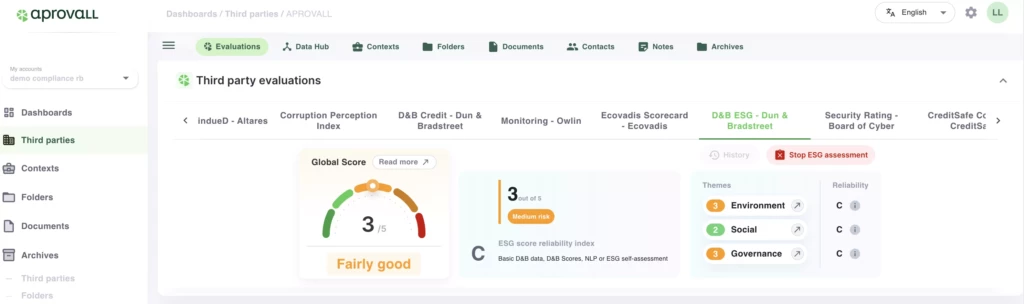
- 3 main scores (E, S, G) to quickly visualize overall third-party commitment.
- 12 detailed sub-scores to refine analysis and identify improvement areas.
- Automated collection of supporting documents, ensuring reliable and streamlined tracking.
A Tool Built for Real-World Use Cases
The Initial ESG Module addresses various challenges faced by Procurement departments:
- Want to assess your suppliers’ ESG maturity before launching a broader initiative? This module offers a clear and structured starting point.
- Need to prepare for CSRD requirements? It helps you collect key initial data and prioritize actions.
- Planning to focus efforts on a specific topic like decarbonization or resource management? The module lets you measure supplier commitment before diving deeper.
Thanks to its pragmatic design, it fits both large corporations and public institutions or mid-sized businesses looking to build their ESG strategy step by step.
Organizational Benefits
The Initial ESG Module is designed to be the first lever of responsible transformation:

Scalability
Start with a baseline ESG assessment and progressively unlock access to advanced modules covering decarbonization, biodiversity, governance, and ethics — without needing to rebuild the evaluation framework.

Structure and clarity
Lay the groundwork for a simple, coherent ESG evaluation method aligned with ESRS standards, producing auditable and comparable results across the entire supply base.
Collective engagement
Raise awareness across internal teams and supplier partners around ESG expectations, creating shared visibility and fostering a culture of responsible third-party governance.

Transparency
Visualize ESG contributions globally or by supply chain segment, with clear scoring that supports reporting, decision-making, and stakeholder communication.
From Baseline Assessment to Strategic ESG Governance
Building a procurement ESG strategy is a progressive journey. The initial assessment phase establishes visibility and identifies where risks and opportunities lie. But the real value emerges when ESG data begins to inform strategic decisions: supplier selection, contract renewals, risk mitigation, and collaborative improvement plans.
Organisations that centralise ESG governance report measurable efficiency gains. With an 80% supplier adoption rate and +30% improvement in response rates, collaborative evaluation platforms reduce supplier fatigue while strengthening data reliability. Teams that consolidate third-party governance save on average 25% of administrative time — the equivalent of 9 days per month — by eliminating redundant tasks and streamlining cross-departmental workflows (source: Aprovall client testimonials).
In summary, an effective procurement ESG strategy delivers three outcomes:
- Reduce administrative complexity and supplier fatigue through structured, automated data collection
- Structure ESG evaluation with a proportionate, standards-aligned methodology that scales with maturity
- Strengthen supply chain resilience by embedding ESG criteria into sourcing decisions and continuous monitoring
Ready to structure your procurement ESG strategy?
Discover how Aprovall’s Initial ESG Module helps Procurement, CSR, and Compliance teams build a clear, scalable ESG evaluation framework — from baseline assessment to advanced monitoring.
You have question ?
We have answer.
Start by mapping ESG priorities against your industry context, regulatory exposure (CSRD, CS3D, REACH), and corporate sustainability commitments. Then segment your supplier base by ESG risk exposure to focus evaluation efforts where they matter most. A structured baseline assessment provides the visibility needed to prioritise actions and build a phased roadmap.
CSRD mandates structured, verifiable non-financial reporting, including Scope 3 supplier data. Procurement teams must collect, consolidate, and verify ESG data from suppliers at scale. This requires moving from estimated metrics to primary supplier data, with traceable documentation and audit-ready reporting.
Supplier ESG maturity assessment evaluates how far a supplier has progressed in integrating environmental, social, and governance practices into operations. It typically produces scores across E, S, and G pillars with detailed sub-scores, enabling Procurement teams to identify gaps, benchmark performance, and prioritise engagement.
Supplier fatigue results from repetitive questionnaires sent by multiple clients. A centralized, collaborative data collection model — where responses are structured, stored, and reusable — limits duplication. This improves response rates, strengthens data consistency, and lowers evaluation costs across the ecosystem.
The primary reference framework under CSRD is ESRS (European Sustainability Reporting Standards). Depending on industry, additional frameworks may apply: GRI for broader sustainability reporting, TCFD for climate-related disclosures, and sector-specific standards for construction (ICPE), chemicals (REACH), or cybersecurity (NIS2).
-
 02 April 2025Understanding Scope 3 Assessment in the Value ChainSolutionsAnticipating Your Carbon Footprint by Assessing Suppliers and Identifying Scope 3 Maturity In a context where third-party environmental governance is becoming a major strategic issue, companies must now evaluate and manage the carbon impact of their entire value chain. Scope 3 assessment represents a considerable but essential challenge to ensure organizations’ operational resilience in the […]
Read more
-
23 January 2025Optimizing Productivity Through Automated Due DiligenceSolutionsAmid increasing regulatory demands and the growing complexity of value chains, third-party governance has become a strategic imperative for European organizations. With over 430,000 third parties managed on its platform, Aprovall supports this transformation by combining regulatory expertise with technological innovation. Automated due diligence is revolutionizing third-party evaluation by leveraging AI-powered predictive document analysis, sector-specific intelligent workflows, and real-time multi-source […]
Read more
-
17 February 2025Supplier Due Diligence: A Key Pillar in Risk ManagementSolutionsSupplier due diligence has become a critical component of third-party governance in a context where nearly 50% of mergers fail due to inadequate partner assessment. This structured approach to collaborative evaluation enables organizations to build operational resilience while ensuring regulatory compliance. The due diligence process is based on a proven methodology of gathering and analyzing third-party information. It systematically covers six critical […]
Read more
-
24 March 2025Pooled Due Diligence: A Strategic Lever for Third-Party Risk ManagementSolutionsIn an increasingly demanding economic environment, companies are turning to pooled due diligence processes to optimize third-party governance and strengthen their operational resilience. This collaborative approach involves sharing the efforts and resources related to third-party partner assessments, particularly critical suppliers. By centralizing these tasks, organizations—both within the same group and even among competitors—can increase efficiency […]
Read more