Aprovall’s Strategic Challenges under CSRD

For Aprovall, which supports over 430,000 third-party partners across Europe, operational resilience is a major strategic priority. A recent study reveals that 55% of companies subject to CSRD face difficulties in managing data quality and consistency. In response, Aprovall’s dual ISO 27001/27701 certification provides a robust framework for ESG data governance.
In the social housing sector, sustainable performance requires an integrated value chain approach. Social landlords must now demonstrate their ability to monitor the environmental impact of their third-party partners, particularly in energy and resource management.
Collaborative evaluation of third parties generates tangible benefits. Companies using this method report a cost reduction of 5 to 10%. For the industrial sector, this also helps optimize the management of classified ICPE facilities while strengthening control over environmental risks.
Challenges in Integrating Sustainability Criteria
The strict application of sustainability criteria presents several challenges. Companies may encounter internal or external resistance when trying to modify procurement processes. Some suppliers may perceive these new requirements as additional burdens, requiring financial and technical investments to meet the new standards.
This is where effective communication plays a crucial role. Clearly explaining the long-term benefits of sustainable practices and providing adequate support can help overcome these objections. For instance, Aprovall offers tailored support to help suppliers conduct environmental and social diagnostics, providing actionable guidance to meet sustainability goals.
Integrating ESG criteria requires a deep transformation of evaluation processes. According to a recent study, 93% of executives view sustainability as critical to success, but only 30% have embedded it into their value chain strategy.
- In the industrial sector, fewer than half of companies have a comprehensive view of third-party sustainability performance. This calls for digital tools that ensure ESG data traceability and transparency.
- In the construction sector, which accounts for 39% of global carbon emissions, this transformation includes waste management and the use of sustainable materials.
Financial Impact of CSRD Compliance
Investing in sustainable practices delivers tangible mid-term benefits. Companies taking a proactive approach to sustainability are reaping the rewards. For e-commerce businesses, optimizing packaging and logistics routes helps reduce both environmental impact and transport costs.
Implementing a sustainable strategy requires a phased approach:
- Systematic assessment of environmental impacts
- Definition of measurable goals by sector
- Implementation of shared performance indicators
This framework helps identify cost-saving opportunities while enhancing value chain resilience—a critical concern in social housing where cost control is vital.
Best Practices and Adaptation Strategies
Adopting best practices in supplier management under CSRD is not only about compliance, but strategic foresight. Several approaches can strengthen sustainability while improving day-to-day operations:
- Transparency and traceability: Ensuring full visibility of supplier practices and performance builds trust and collaboration. Technologies like blockchain can facilitate this.
- Collaborative approach: Co-develop innovative sustainability solutions with suppliers. These partnerships can lead to mutually beneficial innovations.
- Technological integration: Use specialized software to track and manage sustainability data for an up-to-date, holistic view.
- Ongoing training: Regularly train internal teams and suppliers on regulations and best practices.
- Continuous evaluation: Set up continuous assessment mechanisms to adapt strategies based on performance.
Get a free CSRD maturity assessment
with our experts
Strengthening Supplier Relationships
Operational resilience relies on long-term partnerships with third parties. In construction, such collaboration improves waste management and material traceability.
Establishing multi-year agreements is a strategic lever to reinforce third-party commitment. Contractual stability supports investment in sustainable solutions and encourages shared innovation. In the industrial sector, these partnerships ease ICPE compliance and improve production processes.
Reward Systems and Incentives
Implementing a structured incentive program yields measurable results. Leading companies follow a progressive model:
- Public recognition of best practices
- Preferential payment terms
- Priority access to tenders
- Personalized technical support
In social housing, such mechanisms particularly encourage innovation in energy efficiency. Top-performing third-party partners may benefit from multi-year contracts and exclusive access to training programs.
Experience shows that companies incorporating ESG criteria into incentive programs report significant improvements in sustainability performance. This approach also helps reduce Scope 3 emissions while boosting overall supply chain resilience.
Aprovall provides tailored pathways and formats to identify ESG and CSR challenges among third parties—regardless of subcontractor type. These pathways also offer dashboards and reports that can be linked to internal content, highlighting third-party engagement and maturity levels.
-
 16 May 2025Why Assessing Upstream Suppliers Is EssentialSolutionsUpper-Tier Suppliers: The (Too Often) Overlooked Risk in Your Supply Chain Modern procurement chains rely on a multitude of actors, each contributing to value creation—extraction, manufacturing, assembly… The final product is never the result of a single supplier but rather the outcome of an often international ecosystem. Yet, most organizations still focus their efforts and […]
Read more
-
 13 April 2025Automated Financial Scoring: Optimizing Third-Party AssessmentSolutionsIn today’s world of interconnected supply chains, businesses can no longer afford to manage their supplier relationships blindly. A partner’s financial health can quickly become a critical risk factor. This is precisely the view of procurement leaders, who rank the risk of third-party financial failure as their number one concern, according to the AgileBuyer study. […]
Read more
-
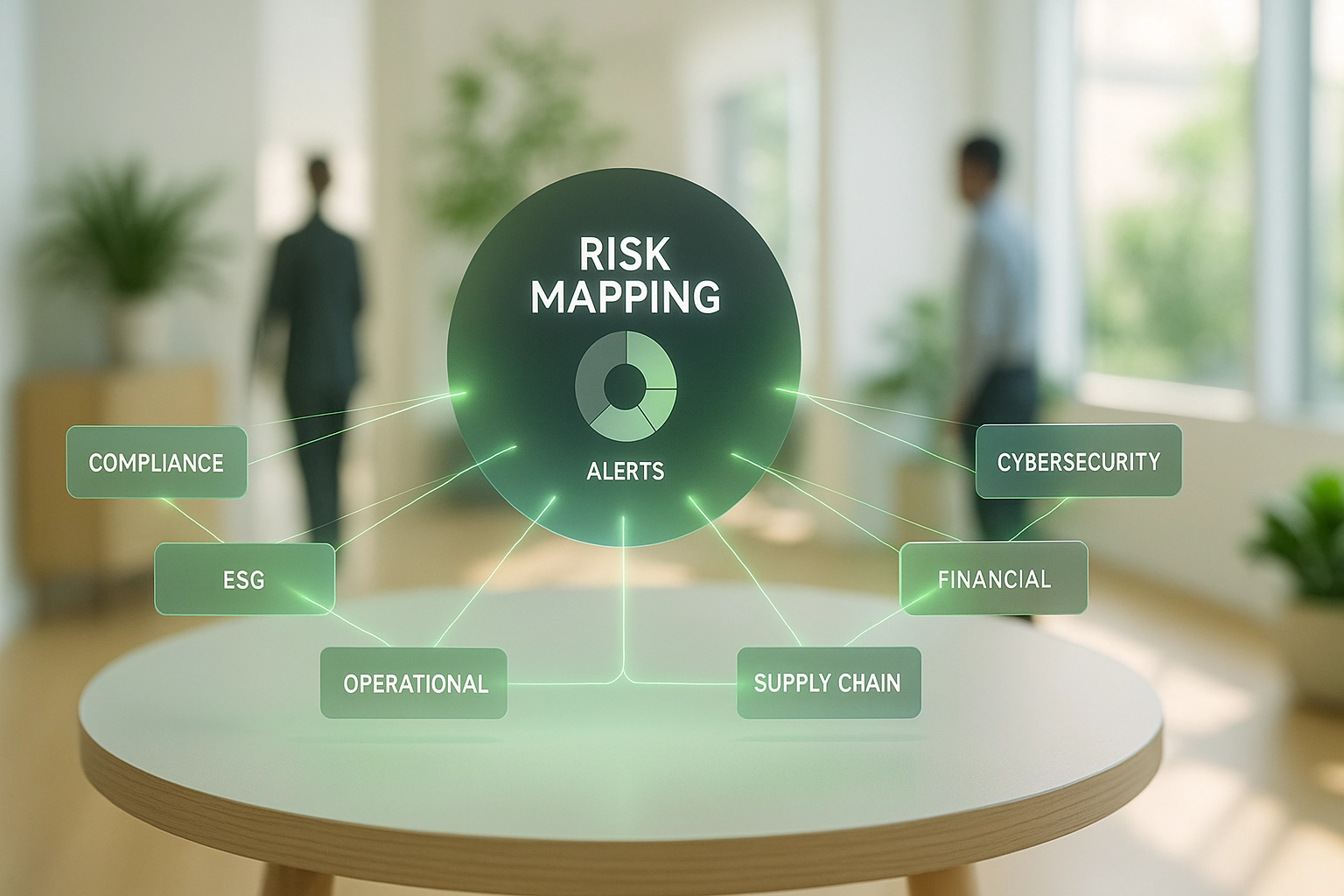 18 July 2025Why Connecting Your Risk Mapping to TPRM Is a Game ChangerSolutionsIn a context where third-party ecosystems are expanding, organizations can no longer afford to manage their vendor relationships blindly. Companies are now selecting partners based on increasingly specific criteria, and many have implemented risk mapping tools to gain a clearer view of the risks posed by their subcontractors. They must actively manage third-party risks. According […]
Read more
-
 03 March 2025Understanding Dynamic Risk Scoring: Fundamentals and Implementation for Third-Party GovernanceSolutionsDynamic risk scoring has become an essential tool for organizations seeking to optimize their third-party governancestrategies. With increasingly complex partnerships and growing regulatory requirements in Europe—particularly DORA and NIS 2—it is crucial to understand how this methodology transforms collaborative assessment of third-party partners. According to data reported by Sprinto, 58% of compliance teams identify assessing third-party responsiveness as their main challenge […]
Read more