TPRM Organizational Silos: How to Break Down Barriers
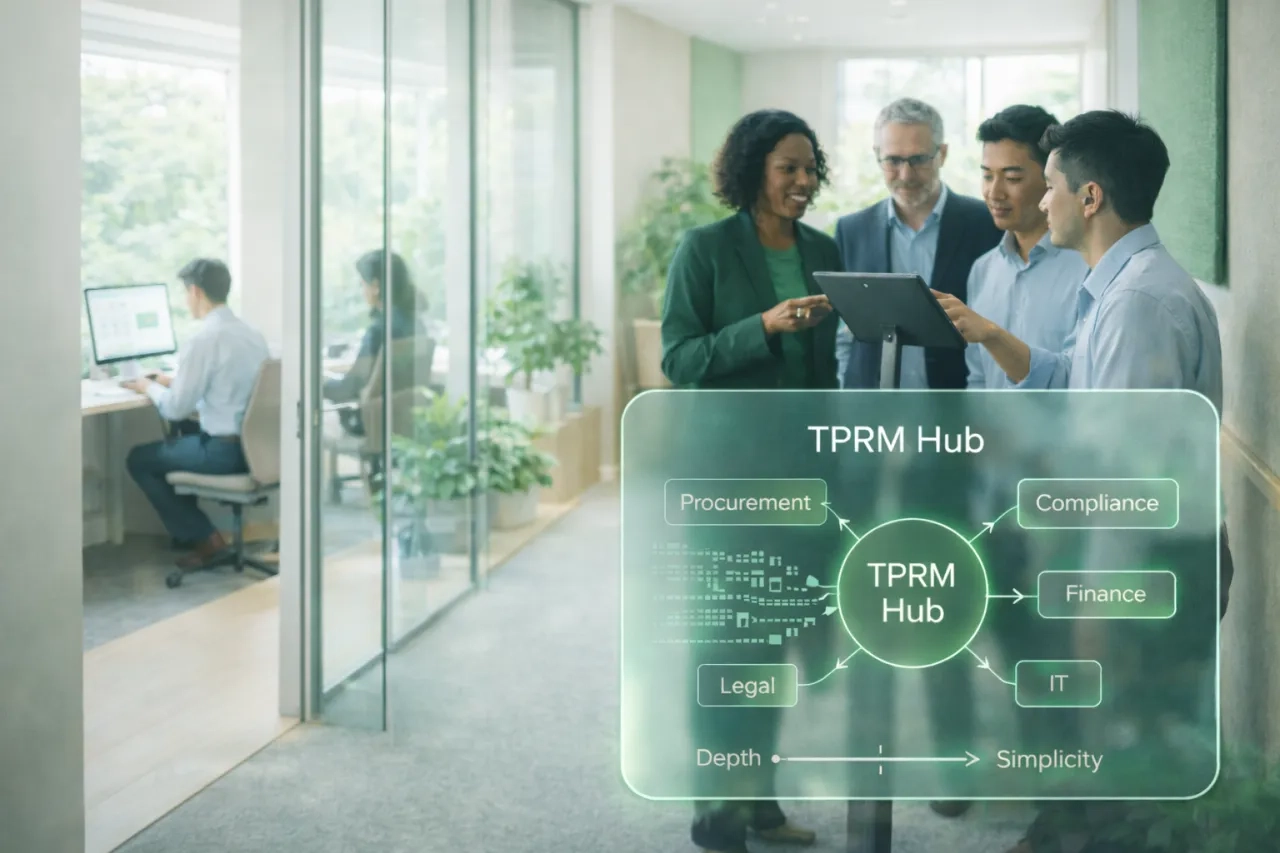
TPRM organizational silos: In many companies, organizational silos remain a persistent reality. Procurement, Legal, Compliance, Finance, and IT often still operate as independent units, each with their own tools, priorities, and metrics. Despite years of digitalization efforts, these internal divisions continue to hinder overall organizational performance.
This siloed structure has consequences. It complicates processes, delays decision-making, and creates ambiguity in responsibilities. A McKinsey study even shows that organizations that foster smooth collaboration between teams can be up to 25% more productive than those working in silos. That figure alone highlights how strategically important this issue is.
Silos Were Tolerated for a Long Time… But Not Anymore
For years, these inefficiencies could be somewhat absorbed. In a relatively stable environment with known and managed risks, organizations managed to operate despite internal friction. Lost time, duplicate efforts, or delayed decisions were often accepted as a “normal cost” of large structures.
But that context has radically changed.
Today’s economic, regulatory, and geopolitical environment is marked by structural instability. Climate risks are intensifying and directly impacting supply chains. Geopolitical tensions are reshaping trade relationships and increasing exposure to sanctions, supply disruptions, and reputational risks. Regulatory demands are multiplying, particularly around compliance, ethics, cybersecurity, and environmental responsibility.
To keep in mind
The year 2026 clearly reflects this acceleration of risk.
Companies must continue to operate, deliver, produce, and innovate in a more constrained, volatile, and demanding environment. In this context, organizational silos are no longer just inefficient — they are dangerous.
Mental Overload: The Hidden Symptom of Silos
Beyond operational inefficiencies, silos generate significant mental strain for teams. Employees must deal with partial information, complex approval chains, and limited visibility into decisions made elsewhere in the organization. They spend time hunting for information, chasing other departments and suppliers, or piecing together scattered histories.
This mental load distracts teams from their actual value-added work. Instead of focusing on risk analysis, crisis anticipation, or process improvement, they devote massive energy to managing internal complexity. In an already high-pressure environment, this model is no longer sustainable.
Why Supplier Risk Management Highlights the Problem
Supplier risk management is one of the clearest — and costliest — examples of silos at work. Procurement oversees the commercial relationship, Legal handles contracts, Compliance monitors regulations, Finance assesses solvency, and IT focuses on cyber risks. Each operates with its own tools and reference frameworks.
The result? A fragmented view of supplier risk, redundant evaluations, delayed and sometimes conflicting decisions. In some cases, a supplier may be commercially approved while posing a significant regulatory or ethical risk — with no proper communication between departments.
This is exactly where Third-Party Risk Management (TPRM) proves its full value.
TPRM as a Catalyst for Cross-Functional Collaboration
TPRM isn’t just a compliance tool or a documentation control system. When well-designed, it becomes a true cross-functional foundation for the organization. It centralizes information, structures processes, and aligns all departments around a shared view of third-party risk.
By establishing a single supplier database shared by all stakeholders, TPRM eliminates much of the organizational friction. Data is no longer duplicated, responsibilities are clarified, and decisions are based on reliable, up-to-date information.
Cross-functional workflows also streamline interdepartmental communication. Each team steps in at the right time, according to their role, with no breaks in the decision chain. Risk is no longer treated in successive silos but managed in a coordinated, continuous way.
From Risk Management to Organizational Trust
One of the key contributions of TPRM is shifting supplier risk management toward a model of organizational trust. Teams no longer spend their time verifying, controlling, or justifying decisions made elsewhere. Instead, they rely on a shared framework, clear rules, and common indicators.
This trust is built on three pillars: information transparency, decision traceability, and automation of first-level controls. By reducing manual tasks and informal exchanges, TPRM frees up time and energy to focus on truly critical risks.
A Prerequisite for Tackling Future Challenges
External risks will continue to escalate, and companies no longer have the luxury of operating in silos. The ability to anticipate, make quick decisions, and coordinate effectively is now a major competitive advantage.
TPRM is becoming a structural lever — far beyond compliance. It breaks down organizational barriers, reduces mental overload for teams, and secures long-term supplier relationships. By erasing silos, it restores what companies need most today: clarity, agility, and trust.
Switch to proactive management today!
With Aprovall, benefit from an intuitive and powerful solution, tailored to the requirements of the most highly regulated sectors. Stop enduring risks: anticipate them, measure them, and manage them with confidence.
-
 11 June 2025Third Parties: Why You Can No Longer Ignore Risk ConvergenceSolutionsWhen it comes to supplier management, focusing on a single risk often means exposing yourself to many others. For a long time, companies have concentrated on financial risks: solvency, credit ratings, payment delays… But recent crises have proven that supplier risks are multiple, systemic, and deeply interconnected. A supplier may be financially sound… yet vulnerable […]
Read more
-
 10 January 2025Supplier Cybersecurity Assessment: Key Criteria and ISO ExpertiseSolutionsIn 2024, cyberattacks have reached a critical level with a projected global cost of $9.5 trillion. The recent Change Healthcare breach, compromising the data of 190 million people, perfectly illustrates the catastrophic risks tied to the supply chain. Faced with this threat, where a new attack occurs every 11 seconds, rigorous supplier cybersecurity assessment has become a strategic pillar of third-party […]
Read more
-
 11 March 2025Comprehensive Methodology for Third-Party Risk MappingSolutionsIn today’s business environment, where relationships with external partners are strategic, third-party governance has become an essential priority. Third-party risk mapping is a critical tool for identifying, structuring, and prioritizingfactors that may impact the organization. According to a recent Gartner study, over 60% of organizations have now implemented a centralized or federated model for managing third-party risks, […]
Read more
-
 09 January 2026Why All-in-One TPRM Platforms Are Becoming Essential in EuropeTPRM&TPGRCEuropean companies increasingly rely on a complex network of partners and suppliers. Each new third party enriches this ecosystem but also increases risk. These risks include cyber threats, operational challenges such as financial or ethical risks, and regulatory requirements. Traditional, often fragmented, TPRM solutions are no longer sufficient. That’s why all-in-one TPRM platforms are gaining […]
Read more