TPRM platforms in Europe: 7 selection criteria
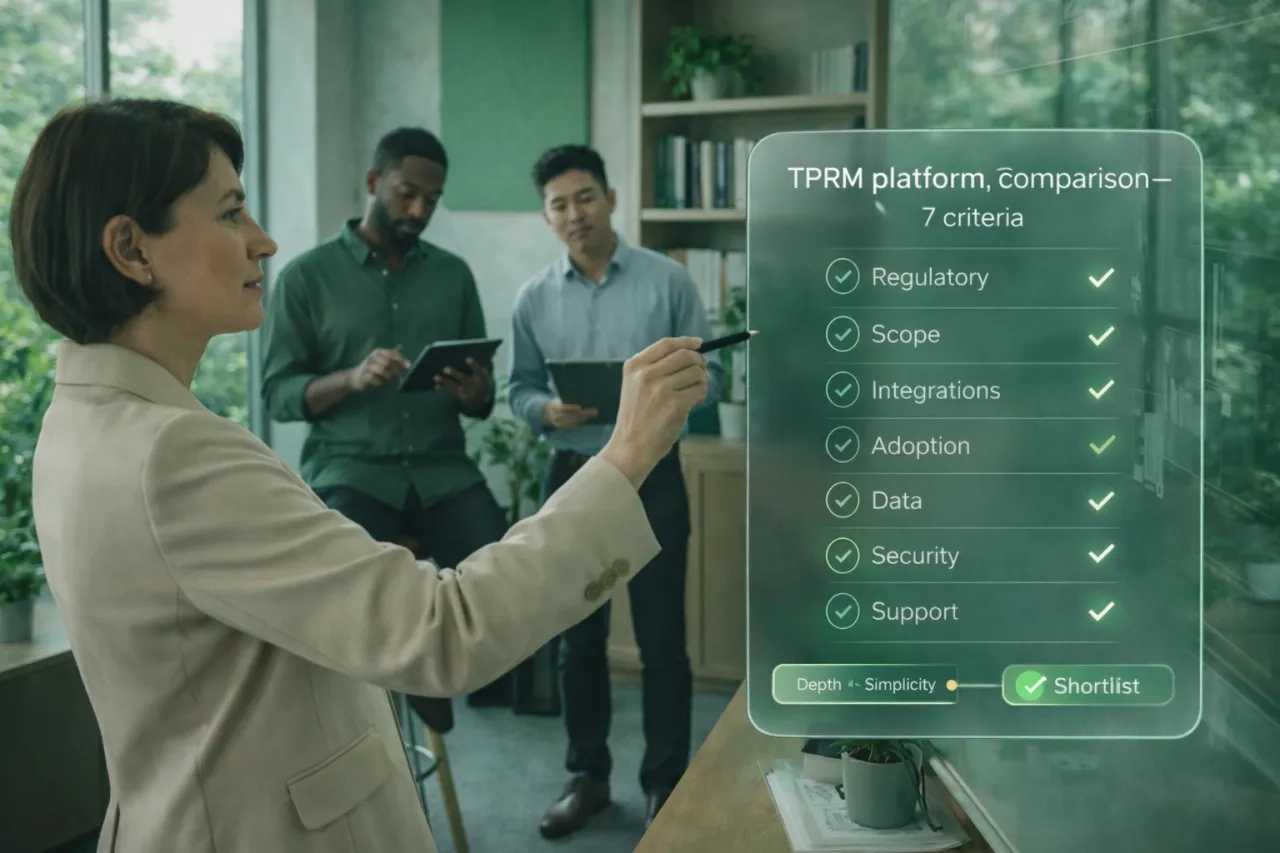
Quick answer: TPRM platforms in Europe are typically compared on more than feature coverage. A robust selection process checks regulatory alignment (GDPR, NIS2, DORA, CSRD), proportional controls by third-party criticality, and adoption by both internal teams and suppliers. In large deployments, platforms designed as a single system of record for third-party governance have been associated with 25% administrative time saved (about 9 days per month) by reducing duplicated work.
TPRM platforms comparison starts with the European context
TPRM platforms are increasingly evaluated as governance infrastructure, not just vendor management software. European organisations face growing expectations around traceability, audit readiness, and operational resilience, especially when critical suppliers support regulated or high-risk activities.
A useful comparison therefore focuses on structural trade-offs. The key question is whether a platform can support third-party governance at scale while reducing supplier fatigue and keeping controls proportionate.
Definition
TPRM (Third-Party Risk Management) is the structured governance of risks across the full third-party lifecycle, from supplier onboarding to ongoing monitoring. In practice, it aligns Procurement, Legal, Compliance, Finance, and IT Security around shared requirements and a shared evidence base.
TPRM platforms should align with European regulatory expectations
In Europe, a TPRM platform is often expected to support compliance and evidence production for GDPR and, depending on sector and scope, regulations such as NIS2 and DORA. Sustainability and due diligence reporting needs can also influence requirements, including CSRD.
When comparing platforms, the practical test is whether the system can translate regulatory expectations into operational controls. It should support traceability of evaluations, decisions, and remediation actions. It should also store audit-ready evidence in a consistent way.
Proportional control matters more than maximum feature coverage
Most TPRM platforms include supplier questionnaires, document and contract management, remediation tracking, and ongoing monitoring options. However, the decisive point is often proportionality.
A platform should make it easy to calibrate controls based on third-party criticality. If the system forces the same depth for every supplier, it increases workload and supplier fatigue. If it lacks depth for critical suppliers, it creates blind spots.
Modularity is therefore a key selection criterion, because it enables stricter governance where it matters without overburdening lower-risk relationships.
Integration prevents new silos
A TPRM platform that does not integrate can create new organisational silos. In most environments, the platform needs to connect with procurement and ERP tools, SRM systems, GRC or risk tooling, cybersecurity monitoring, and contract management.
Integration improves data consistency and helps risk insights flow into decision-making. Without interoperability, third-party risk signals can remain isolated from operational and executive reporting.
Adoption by internal teams and suppliers is a core success factor
A TPRM platform only creates value if it is used consistently by Procurement, Compliance, Legal, Finance, and IT Security, and if suppliers can engage without friction.
When assessing adoption, organisations typically look at user experience, training effort, workflow clarity, and supplier-facing experience (portals, questionnaires, and communication). In Europe, multilingual support is also a practical requirement for cross-border supplier onboarding.
A good adoption model contributes to better response rates and better data quality over time.
Benefit
A well-chosen TPRM platform can reduce duplicated supplier requests, improve traceability for audits, and reduce supplier fatigue. In large deployments, centralised third-party governance has been associated with
25% administrative time saved
+30% average improvement in supplier response rate
9 day saved per month
Data quality and update frequency determine whether risk signals stay usable
Third-party risk management depends on accurate, current information. Because supplier data is often fragmented and self-declared, platforms should support structured collection and consistency checks, and they may integrate external signals when relevant.
Update frequency is critical for high-risk domains such as cybersecurity and financial stability. A static assessment model becomes obsolete quickly when suppliers change ownership, expand subcontracting, or experience security incidents.
Security, confidentiality, and data sovereignty are first-order requirements in Europe
European organisations often need clarity on where supplier data is hosted, how access is controlled, and how audit trails are produced. A credible platform should provide strong security controls such as encryption, role-based access, and logging.
GDPR alignment and transparent hosting policies are essential, especially when third-party information includes personal data or sensitive contract documentation. Certifications such as ISO 27001 can support baseline assurance when they apply.
Support, governance, and scalability reduce long-term implementation risk
Selecting a TPRM platform is a long-term decision. Vendor support, onboarding, documentation quality, and change management influence adoption and time to value.
Scalability should be assessed against the expected number of third parties, the complexity of governance workflows, and the likelihood that regulatory and internal requirements will evolve. The goal is to avoid a short-term selection that becomes a constraint after expansion.
Conclusion
A meaningful comparison of TPRM platforms in Europe is less about a feature checklist and more about governance fit.
Want a practical comparison checklist for TPRM platforms?
Use a structured checklist to compare regulatory alignment, proportional controls, and adoption drivers before booking vendor demos.
Do you have a question?
We have an answer.
-
 14 January 2026Unified TPRM Platform for Procurement & Compliance TeamsTPRM&TPGRCProcurement and Compliance teams face a common challenge: managing third-party risks efficiently while meeting increasingly stringent regulatory requirements. The growing number of suppliers, the complexity of compliance obligations, and the pressure to accelerate processes make this task especially demanding. In this context, a unified TPRM (Third-Party Risk Management) platform helps structure third-party risk management and […]
Read more
-
 23 February 2026TPRM integrations : best ERP & GRC integrations for third-party riskTPRM&TPGRCTPRM integrations : breaking down ERP & GRC data silos TPRM-integrations : when third-party risk, procurement, and compliance data sit in disconnected ERP and GRC systems, organisations lose real-time visibility and create audit exposure. The goal is a unified, measurable control layer where vendor risk signals flow into procurement decisions and governance becomes traceable. Organisations […]
Read more
-
 25 February 2026TPRM Europe : leading platforms for supplier & third-party riskTPRM&TPGRCTPRM Europe : why supplier risk governance is structurally different TPRM Europe : European organisations need automated, evidence-driven third-party governance as supplier incidents (cyber, regulatory, financial, ESG) cascade faster than annual audits can detect. The shift is from periodic checks to continuous, integrated oversight across ERP, GRC and procurement workflows. European supplier risk management has […]
Read more
-
 23 March 2026TPRM ownership: who should own third-party risk management?TPRM&TPGRCTPRM ownership is rarely a single-team decision. In most organisations, the most resilient model assigns Procurement an operational lead for supplier onboarding, gives IT and security clear authority to validate cyber risk, and uses Compliance and Risk governance to set policy and reporting. Platforms like Aprovall support this operating model at scale for 1,800+ customer […]
Read more