European Union Deforestation Regulation (EUDR): What Companies Need to Know to Ensure Compliance
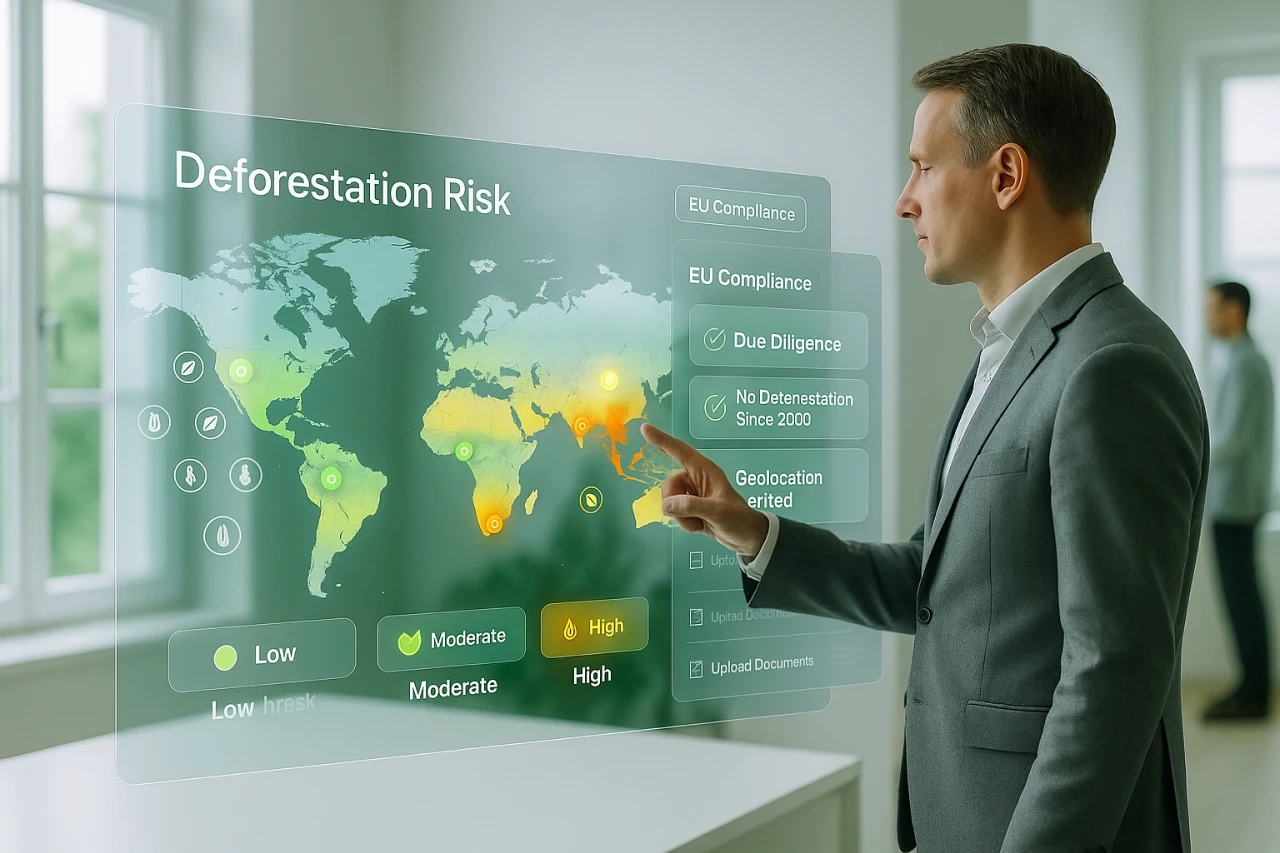
Global deforestation is one of the leading drivers of climate change and biodiversity loss. According to the FAO, nearly 10 million hectares of forest disappear every year, mainly due to agricultural expansion. As the world’s second-largest importer of embedded deforestation, the European Union has decided to act. It is in this context that Regulation (EU) 2023/1115, known as the European Union Deforestation Regulation (EUDR), was adopted. Its objective: to prohibit the placing on the EU market or export of products linked to deforestation after December 31, 2020.
But beyond its environmental goal, this regulation significantly transforms how companies manage their supply chains. It introduces new obligations around traceability, compliance, and due diligence that will affect all stakeholders—importers, manufacturers, distributors, and public operators.
Understanding the European Union Deforestation Regulation
The EUDR was published in the EU Official Journal on June 9, 2023, and entered into force on June 29, 2023. It applies to commodities most associated with deforestation:
The annex also includes derived products such as chocolate, paper, furniture, and certain cosmetics and hygiene products.
The regulation’s goal is clear: ensure that products consumed or exported from the EU do not contribute to deforestation or forest degradation.
Timeline and Deadlines
Although the regulation is in force, its effective application has been delayed by one year to allow companies time to prepare.
| Type of Company | Original Application Date | New Application Date |
|---|---|---|
| Large Enterprises | December 30, 2024 | December 30, 2025 |
| Micro, Small, and Medium-sized Enterprises | June 30, 2025 | June 30, 2026 |
From December 30, 2025, all large enterprises placing regulated products on the EU market must prove they are “deforestation-free.” SMEs will have an additional six months to comply.
Key Obligations for Companies
The regulation requires companies to implement a structured due diligence system to ensure product compliance and traceability.
1. Due Diligence
Companies must:
- Collect information about suppliers, material origins (plot-level geolocation), volumes, and local compliance.
- Assess the risk of deforestation or legal non-compliance in the country of origin.
- Implement mitigation measures such as audits, contractual guarantees, or enhanced monitoring.
2. Traceability
Each company must be able to geolocate the source plot of raw materials and prove no deforestation has occurred since December 31, 2020.
3. Legal Compliance
Products must comply with all relevant environmental, land use, and labor laws of the country of origin.
4. Declaration and Documentation
Before being placed on the market, a due diligence statement must be submitted to the European Information System. This document, accessible to authorities, proves product compliance.
5. Controls and Sanctions
Member States will conduct regular checks.
Non-compliance may lead to fines of up to 4% of annual EU turnover and even temporary bans on marketing the products.
These obligations are prompting companies to adopt TPRM solutions that automate third-party interactions and documentation.
Key Challenges in Achieving Compliance
1. The Complexity of Traceability
Obtaining reliable geolocation data—especially in long or informal supply chains—is a major challenge.
2. Inclusion of Small Producers
Local actors often lack the technical resources to comply and risk exclusion from the European market.
3. Cost and Administrative Burden
Audits, data collection, and system updates require significant effort.
4. Commercial Risk
Non-compliant products may be blocked at EU borders, leading to major economic impacts.
5. Varied National Approaches
Each Member State will apply the regulation based on its resources and priorities, creating potential disparities in enforcement.
How to Prepare Effectively
The key to EUDR compliance lies in anticipation and structure.
Companies should:
- Map their supply chain
- Identify affected products and suppliers
- Implement automated ESG and geolocation data collection systems
- Train internal teams
- Centralize all information in a unified platform
Solutions like Aprovall already enable digitization of these processes: third-party assessment, document traceability, compliance checks, supply chain mapping, and automated alerts.
A Broader Regulatory Ecosystem
The EUDR is part of a larger regulatory ecosystem, including the CSRD (non-financial reporting) and the upcoming CSDDD/CS3D (Corporate Sustainability Due Diligence Directive).
These regulations converge toward a shared ambition:
“Ensure that European companies operate in a sustainable, transparent, and human- and environmentally respectful manner.”
In other words, the EUDR is just the first step toward a responsible, verifiable European supply chain.
Ready to strengthen your third-party risk management program?
-
 18 April 2025ESG Strategy for the Supply Chain: Assessment and Management MethodsSolutionsThe ESG strategy (Environment, Social, Governance) has become a fundamental pillar of corporate operational resilience. According to the 2025 Supply Chain ESG Risk Outlook by LRQA, over half of sourcing countries are now classified as high or extreme ESG risk, challenging the common perception that Western markets are inherently safer. This new reality demands a […]
Read more
-
 03 February 2025TPRM vs Traditional Risk Management: A Critical Comparison for Modern BusinessesSolutionsIn a market valued at $8.3 billion in 2024 and projected to reach $18.7 billion by 2030, third-party governance is becoming a strategic pillar for organizations. In response to the rapidly evolving business world, Third Party Risk Management (TPRM) is profoundly transforming traditional risk management practices. The traditional approach, focused on internal processes, is no longer sufficient […]
Read more
-
 06 February 2025Effective Third-Party Governance: A Holistic Approach to Optimized Risk ManagementSolutionsIn a context where 38% of companies have experienced major disruptions due to third-party partners over the past three years, third-party governance is becoming a strategic imperative. This reality is even more critical as 90% of organizations now consider third-party risk management a growing priority. Effective third-party management relies on a holistic approach integrating six key areas of expertise: Legal […]
Read more
-
 14 March 2025Integrating ESG Criteria into Supplier EvaluationSolutionsIntegrating environmental, social, and governance (ESG) criteria into the evaluation of third-party partners has become essential for companies seeking to strengthen their operational resilience and promote sustainable development. These criteria make it possible to analyze not only economic performance but also the environmental and social impact of business relationships. According to a recent McKinsey study, […]
Read more