Why All-in-One TPRM Platforms Are Becoming Essential in Europe

European companies increasingly rely on a complex network of partners and suppliers. Each new third party enriches this ecosystem but also increases risk. These risks include cyber threats, operational challenges such as financial or ethical risks, and regulatory requirements. Traditional, often fragmented, TPRM solutions are no longer sufficient. That’s why all-in-one TPRM platforms are gaining popularity across Europe.
Why Is an All-in-One TPRM Platform Essential?
A Rapidly Growing TPRM Market
Third-party risk management has become a top priority, and the global TPRM market is expanding quickly. According to Grand View Research, the global TPRM market grew by 15% between 2024 and 2030. This surge reflects growing investments in tools to manage complex third-party ecosystems in an interconnected economy.
Three drivers fuel this growth: regulatory inflation, supplier incidents, and mounting pressure for ESG transparency. Europe is at the heart of this movement, with companies striving to meet stringent standards.
Key Stats
50 000
The CSRD will affect over 50,000 companies by 2026 (European Commission).
2025
DORA, starting in 2025, enhances digital resilience for financial services.
160 000
NIS2 will cover over 160,000 entities across critical sectors (ENISA).
60%
Forrester reports 60% of security incidents originate from third parties.
60%
60% of bank detail fraud stems from fake suppliers (SIS-ID).
30%
TPRM platforms reduce onboarding time by 30% and improve risk coverage by 40% (Eurostat 2023).
A Particularly Strong Regulatory Pressure in Europe
European organizations face a major regulatory shift. The CSRD demands transparency in value chains, forcing companies to rethink their reporting practices.
In the financial sector, DORA and NIS2 raise security requirements. These regulations require continuous third-party risk management. Without an integrated platform, traceability becomes difficult, raising non-compliance risk.
Why Traditional TPRM Approaches No Longer Work
Companies have long relied on fragmented tools to manage third-party risks. But in the context of globalized supply chains, this model falls short. Organizations now need to monitor the entire procurement chain—including higher-tier suppliers.
Many companies admit that their current TPRM programs fall short, especially in managing the full third-party lifecycle—from onboarding to offboarding.
Fragmented Tools and Data
Third-party data is often scattered, making it difficult to obtain a consolidated view of risk. Teams operate with separate systems, resulting in partial evaluations and inefficient risk management.
This fragmentation causes duplicate evaluations, onboarding delays, and difficulty prioritizing audits—all of which can compromise security.
Failure to Cover the Full Third-Party Lifecycle
Organizations often focus on onboarding, but monitoring fades due to lack of resources. A robust TPRM program must address the entire lifecycle to ensure ongoing, proactive risk management:
- Pre-selection and supplier qualification
- Initial evaluation and contracting
- Continuous monitoring and remediation plans
- Periodic re-evaluation and secure offboarding

Aprovall is recognized as a Representative Vendor in the 2025 Gartner® Market Guide for Third-Party Management Technology Solutions
The Key Role of All-in-One TPRM Platforms
TPRM platforms centralize data, workflows, and controls. They bring all stakeholders onto the same page with a shared risk language, enabling better collaboration and decision-making.
These solutions cover the full process—from sourcing to continuous monitoring—shifting organizations from a manual to a strategic TPRM approach that optimizes both resources and outcomes.
Centralization and Process Automation
An all-in-one platform offers a single third-party repository. Each supplier has a consolidated profile containing all relevant data, enabling more efficient and transparent management.
Automation triggers assessments, follows up with suppliers, and generates standardized reports. This reduces manual tasks and improves traceability, allowing teams to focus on higher-value activities.
AI-Enhanced Governance
AI strengthens data analysis, aggregates external streams, and dynamically adjusts risk levels, offering real-time responsiveness to potential threats.
AI doesn’t replace experts—it supports them. It detects weak signals, recommends remediation paths, and enhances organizational resilience.
Challenges Unique to the European Context
European companies operate in cross-border value chains. An all-in-one TPRM platform helps orchestrate this complexity, enabling risk management across multiple jurisdictions.
It consolidates risks traditionally managed in silos—cybersecurity, compliance, resilience, and ESG—simplifying multi-regulation compliance and reducing cost and effort.
Multi-Country, Multi-Regime Value Chains
European organizations have suppliers across numerous jurisdictions. Risks evolve quickly, requiring constant adaptation.
A TPRM platform visualizes this geographical spread, segments third parties by region, and facilitates dialogue with authorities to maintain ongoing compliance.
Integrating ESG, Cyber, and Resilience Into One Framework
ESG and digital compliance demands are converging. TPRM platforms support this integrated approach, enabling more holistic risk management.
They provide a shared language across ESG, risk, IT, and procurement teams—demonstrating that third-party risks are actively monitored and managed, strengthening stakeholder trust.
Industry Examples in Europe
Retail
In retail, volatility among international suppliers requires close monitoring of social and logistical risks.
Industry & Energy
In industry and energy, operational continuity depends on a clear view of critical third parties.
Luxury
In luxury, ESG traceability and compliance are essential to protect brand reputation.
Public sector
In the public sector, transparency and compliance obligations shape third-party evaluation practices.
Preparing Your Organization for TPRM Platform Adoption
Adopting an all-in-one TPRM platform is an organizational transformation. Adequate preparation ensures maximum benefit.
Clarify Needs and Key Use Cases
Clearly defining TPRM expectations is crucial. This guides platform design and ensures alignment with strategic goals.
Map third-party types and associated risks. Identify current processes and their limitations for successful integration.
Structure Governance and Change Management
An all-in-one platform brings diverse teams together. Clear governance is essential to coordinate efforts and ensure buy-in.
Change management is key. Users must understand the platform’s value to fully embrace it.
Discover Aprovall’s TPRM Platform
Aprovall, a European TPGRC platform, helps you manage third-party risks effectively. Book a personalized demo to see how Aprovall can transform your supplier management and strengthen your resilience.
-
 14 January 2026Unified TPRM Platform for Procurement & Compliance TeamsTPRM&TPGRCProcurement and Compliance teams face a common challenge: managing third-party risks efficiently while meeting increasingly stringent regulatory requirements. The growing number of suppliers, the complexity of compliance obligations, and the pressure to accelerate processes make this task especially demanding. In this context, a unified TPRM (Third-Party Risk Management) platform helps structure third-party risk management and […]
Read more
-
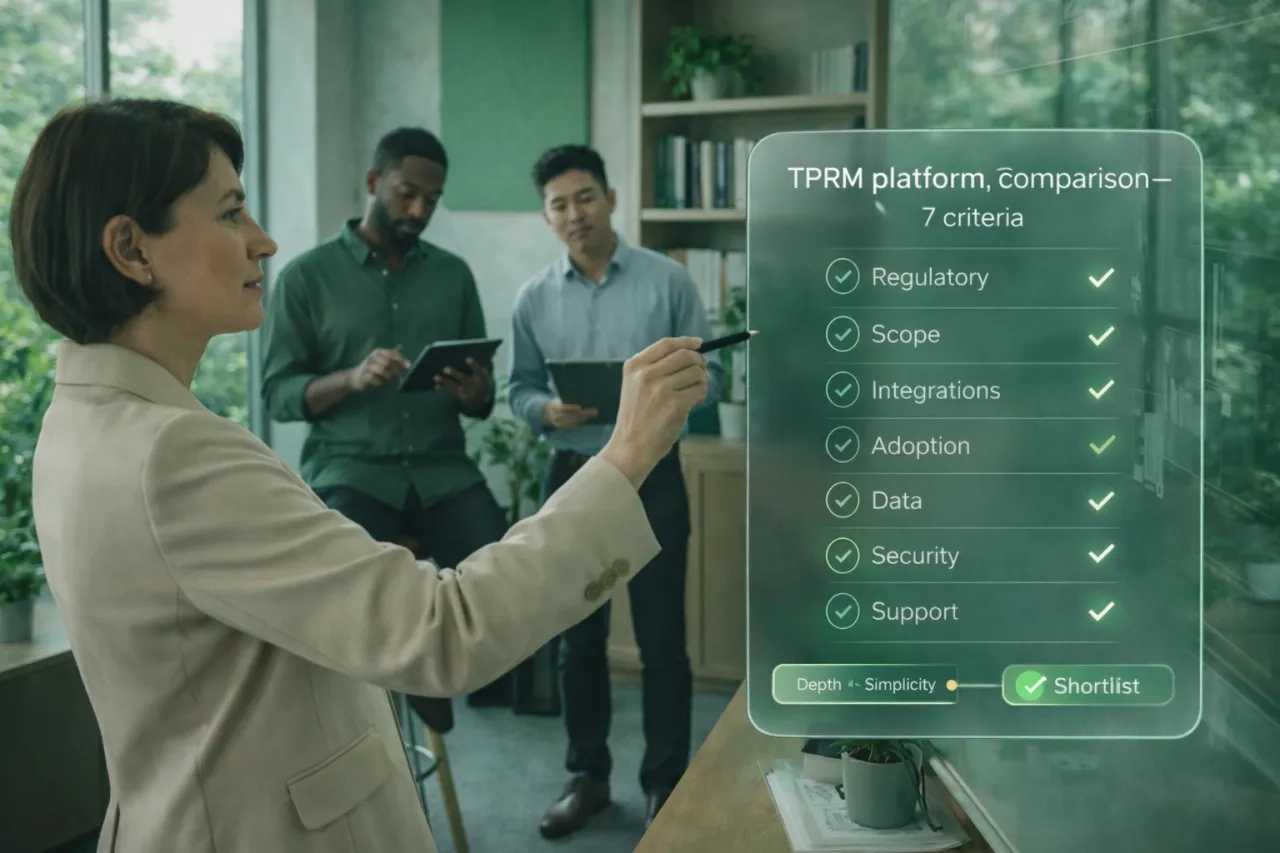 15 January 2026TPRM platforms in Europe: 7 selection criteriaTPRM&TPGRCQuick answer: TPRM platforms in Europe are typically compared on more than feature coverage. A robust selection process checks regulatory alignment (GDPR, NIS2, DORA, CSRD), proportional controls by third-party criticality, and adoption by both internal teams and suppliers. In large deployments, platforms designed as a single system of record for third-party governance have been associated […]
Read more
-
 23 February 2026TPRM integrations : best ERP & GRC integrations for third-party riskTPRM&TPGRCTPRM integrations : breaking down ERP & GRC data silos TPRM-integrations : when third-party risk, procurement, and compliance data sit in disconnected ERP and GRC systems, organisations lose real-time visibility and create audit exposure. The goal is a unified, measurable control layer where vendor risk signals flow into procurement decisions and governance becomes traceable. Organisations […]
Read more
-
25 February 2026TPRM Europe : leading platforms for supplier & third-party riskTPRM&TPGRCTPRM Europe : why supplier risk governance is structurally different TPRM Europe : European organisations need automated, evidence-driven third-party governance as supplier incidents (cyber, regulatory, financial, ESG) cascade faster than annual audits can detect. The shift is from periodic checks to continuous, integrated oversight across ERP, GRC and procurement workflows. European supplier risk management has […]
Read more