TPRM Europe : leading platforms for supplier & third-party risk

TPRM Europe : why supplier risk governance is structurally different
TPRM Europe : European organisations need automated, evidence-driven third-party governance as supplier incidents (cyber, regulatory, financial, ESG) cascade faster than annual audits can detect. The shift is from periodic checks to continuous, integrated oversight across ERP, GRC and procurement workflows.
European supplier risk management has entered a structural transformation phase. A single supplier incident—cyberattack, regulatory breach, financial failure—can cascade across operations within hours. Production halts, data exposure, and reputational damage increasingly originate outside the organisational perimeter.
Traditional annual audits and spreadsheet-based tracking cannot keep pace with:
European organisations now require structured, automated, and evidence-driven third-party governance models.
Why Supplier Risk Is Structurally Different in Europe
Europe’s regulatory environment combines:
The distinguishing characteristic is cascading accountability.
Organisations are increasingly expected to demonstrate oversight not only of direct suppliers, but of extended value chains.
This transforms supplier risk from periodic assessment into continuous governance.
GDPR-Compliant Vendor Risk Assessment: Beyond Checklists
From “Processor Confirmation” to Ongoing Oversight
Under GDPR obligations, organisations must ensure that vendors processing personal data provide appropriate technical and organisational measures.
In practice, this requires:
Manual processes do not scale effectively beyond a few dozen suppliers.
Modern vendor risk assessment platforms address this by:
Risk-Tiered Assessments Improve Proportionality
Not all suppliers present equal risk exposure.
Effective TPRM platforms apply tiered frameworks based on:
This prevents overburdening low-risk suppliers while applying deeper scrutiny to critical third parties.
Data Residency and Sovereignty in the Post-Schrems II Environment
Data transfer compliance now requires clarity about:
Leading platforms support:
True data sovereignty involves both storage and processing controls—not just hosting location declarations.
Automated Third-Party Risk Monitoring: From Snapshot to Signal
Annual assessments provide point-in-time assurance.
Automated third-party risk monitoring provides continuous visibility.
This evolution reflects the reality that supplier risk profiles change rapidly due to:
Real-Time Cyber Risk Monitoring
Leading solutions aggregate signals from:
The objective is contextualised insight, not just a risk score.
Effective systems:
Financial and Operational Health Monitoring
Supplier distress rarely emerges without warning.
Continuous monitoring may include:
Risk-based alert thresholds reduce noise while prioritising critical suppliers.
TPRM vs SRM: Understanding the Strategic Difference
Confusion between Third-Party Risk Management (TPRM) and Supplier Relationship Management (SRM) often complicates platform selection.
| TPRM | SRM |
|---|---|
| Focus: Risk mitigation | Focus: Value creation |
| Primary users: Risk, Legal, Compliance | Primary users: Procurement |
| Goal: Avoid disruption and penalties | Goal: Optimise cost and performance |
Most mature organisations require both.
However, the sequencing depends on risk exposure.
The strongest implementations integrate risk signals into procurement decision workflows rather than isolating them in compliance systems.
ESG and Supply Chain Due Diligence Expansion
European due diligence frameworks expand supplier risk categories beyond cyber and financial risk to include:
This requires:
Platforms that cannot extend beyond traditional cyber/financial risk struggle to support modern ESG requirements.
Integration: The Determining Factor in Platform Success
TPRM platforms that operate in isolation create friction.
Effective European implementations require:
Without integration:
Future-Proofing European Supplier Risk Strategy
European regulation continues to evolve:
Future-ready platforms demonstrate:
Organisations that treat supplier risk management as strategic infrastructure—not compliance overhead—are better positioned to:
Structuring European Third-Party Governance at Scale
For organisations seeking a European-aligned approach to supplier governance, platforms like Aprovall centralise third-party documentation, automate multi-domain risk assessments (cyber, financial, legal, ESG), and maintain audit-ready compliance workflows.
The objective is not only to pass audits, but to build structured, scalable third-party governance that strengthens operational resilience.
Explore how a European-built TPGRC platform can support your supplier risk strategy.
Don’t miss this opportunity to connect with our team, see our solutions in action, and discuss how Aprovall can help you drive procurement excellence and stronger supplier risk management.
-
 03 January 2026Who Needs an All-in-One TPRM Platform in Europe: SMEs to EnterprisesTPRM&TPGRCThird-party risk management (TPRM) has become a structural issue for European businesses of all sizes. IT outsourcing, industrial subcontracting, critical suppliers, service partners—every third-party relationship extends the value chain… and the risk surface. But given the variety of tools and approaches available, one question often arises: At what point does an all-in-one TPRM solution actually […]
Read more
-
 14 January 2026Unified TPRM Platform for Procurement & Compliance TeamsTPRM&TPGRCProcurement and Compliance teams face a common challenge: managing third-party risks efficiently while meeting increasingly stringent regulatory requirements. The growing number of suppliers, the complexity of compliance obligations, and the pressure to accelerate processes make this task especially demanding. In this context, a unified TPRM (Third-Party Risk Management) platform helps structure third-party risk management and […]
Read more
-
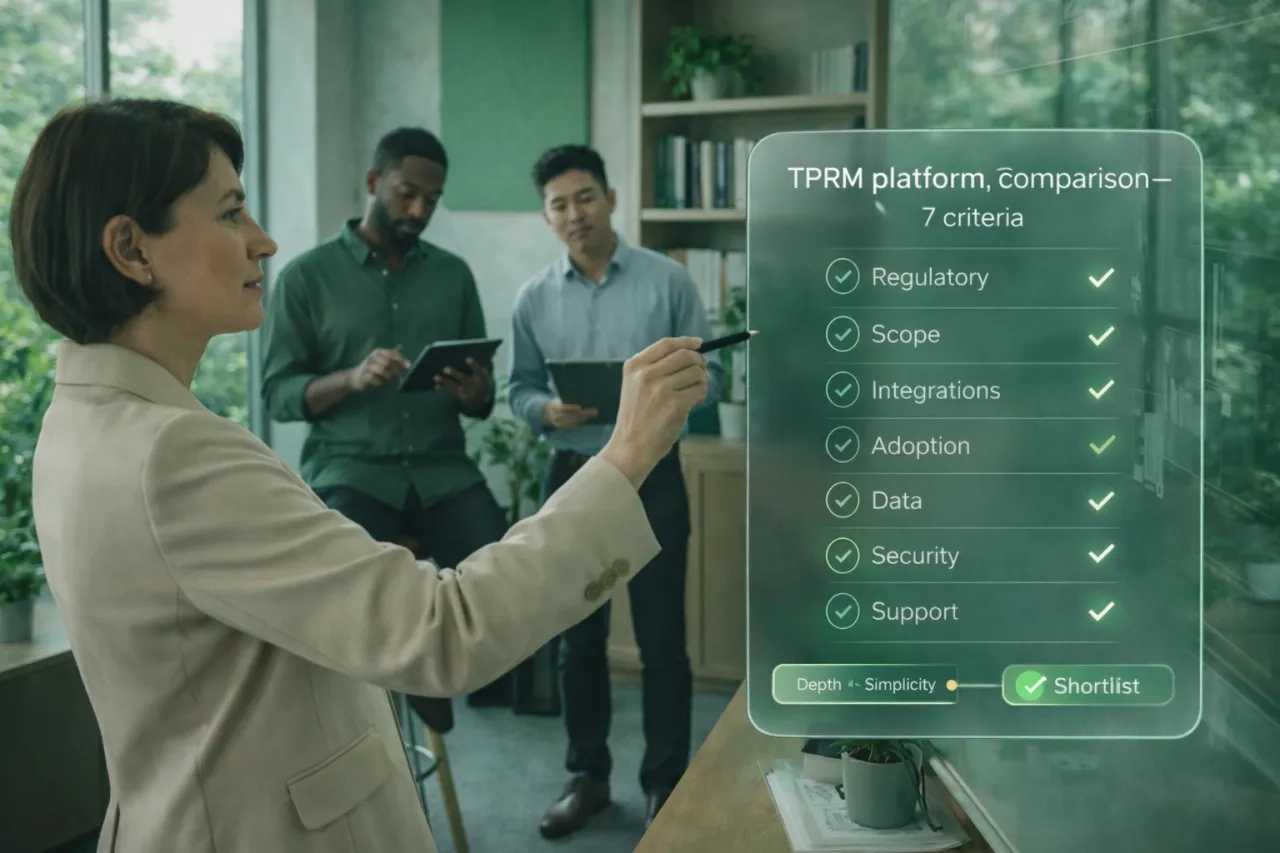 15 January 2026TPRM platforms in Europe: 7 selection criteriaTPRM&TPGRCQuick answer: TPRM platforms in Europe are typically compared on more than feature coverage. A robust selection process checks regulatory alignment (GDPR, NIS2, DORA, CSRD), proportional controls by third-party criticality, and adoption by both internal teams and suppliers. In large deployments, platforms designed as a single system of record for third-party governance have been associated […]
Read more
-
 23 February 2026TPRM integrations : best ERP & GRC integrations for third-party riskTPRM&TPGRCTPRM integrations : breaking down ERP & GRC data silos TPRM-integrations : when third-party risk, procurement, and compliance data sit in disconnected ERP and GRC systems, organisations lose real-time visibility and create audit exposure. The goal is a unified, measurable control layer where vendor risk signals flow into procurement decisions and governance becomes traceable. Organisations […]
Read more