Supplier Onboarding: Controlled Automation Without Losing Compliance

Supplier Onboarding: Automate Processes While Preserving Governance
Supplier onboarding must balance speed with control. Procurement teams need to onboard vendors faster while ensuring rigorous verification of compliance, banking data, and regulatory exposure. Controlled automation—combining supplier portals, automated screening, workflow approvals, and audit trails—allows organisations to accelerate onboarding while strengthening governance and traceability.
Industry research consistently shows that organisations that automate supplier management materially reduce cycle times while improving compliance outcomes. The differentiator is not “more automation,” but better-designed automation—automation that reinforces governance rather than bypassing it. The goal is not to remove checkpoints. It is to make checkpoints faster, more consistent, and fully auditable.
That shift requires treating onboarding as a structured, end-to-end workflow instead of a sequence of ad hoc tasks. When each step is governed by data validation, approval triggers, and audit logging, you gain operational visibility that manual processes can’t match. The five steps below outline a practical framework for building controlled supplier onboarding automation at scale.
Step 1 — Centralise Supplier Data Collection with Self-Service Portals
Controlled automation starts by eliminating fragmented data collection: spreadsheets via email, documents scattered across shared drives, and supplier information trapped in inboxes. A self-service supplier portal turns this chaos into a single source of truth.
A portal shifts data entry to suppliers while enforcing structure and standardisation. Suppliers complete guided forms, upload required documents, and acknowledge policies in one place—capturing data in formats that downstream systems can validate and process automatically.
Make the portal a control point, not a convenience layer:
Reduce errors by validating at the point of entry
Manual re-keying introduces avoidable errors: mistyped VAT numbers, misformatted bank details, spelling inconsistencies in legal entity names. Portal validation catches issues immediately, before they spread into ERP, AP, and contract repositories.
Where possible, validate against external sources (e.g., company registries) and flag inconsistencies for review. This shifts your organisation from reactive correction to proactive prevention.
Standardise documentation with dynamic requirements
Different supplier types require different controls. A software vendor is not assessed like a facilities contractor. Replace static “one-size-fits-all” checklists with dynamic document requirements based on supplier category, geography, and inherent risk.
A tailored checklist improves supplier experience while ensuring you collect what matters—no gaps, no noise.
Step 2 — Embed Automated Compliance and Due Diligence Screening
Compliance is the highest-stakes part of onboarding. Missing a sanctioned entity, failing to detect a politically exposed person (PEP) in the ownership structure, or accepting invalid tax registration exposes the business to material liability.
Automation improves compliance not just through speed, but through consistency, coverage, and repeatability. It also enables a critical upgrade: moving from point-in-time checks to continuous monitoring.
Real-time sanctions and risk screening
Integrate onboarding with watchlist screening and risk data sources so checks run automatically when a supplier submits information. Screening typically includes:
Best practice: flag potential matches for human review. Name-based screening generates false positives—especially for common surnames and transliterations. Automation should scale the detection; humans should confirm the decision.
Continuous monitoring matters just as much. Automated alerts should trigger when:
Automated VAT and tax identity verification
Use tax validation services (e.g., VIES in the EU; relevant national APIs where available) to confirm VAT/tax IDs and match them against the declared legal entity. Record verification results with timestamping to build a durable audit trail.
Step 3 — Implement Multi-Level Approval Workflows That Enforce Governance
Automation without governance creates risk. The goal is workflow automation that enforces approvals while eliminating the friction of manual routing and “lost in inbox” delays.
Approval paths should be rules-based and proportional:
A workflow engine should:
Role-based access and authorisation
Controlled onboarding requires least-privilege access:
This protects sensitive information and prevents inappropriate approvals—while keeping each reviewer focused on what they own.
Step 4 — Integrate Seamlessly with ERP and Core Systems
Automation delivers full value only when approved suppliers flow into the systems where they’re needed—without re-entry. Manual creation of vendor master records after onboarding is one of the most common sources of both delay and error.
Treat the onboarding platform as the master data gateway:
Integration must include:
Where relevant, bi-directional integration helps maintain a unified view (e.g., ERP deactivation or payment hold status syncing back to the supplier risk profile).
Step 5 — Prove Control with Automated Audit Trails and Performance Monitoring
Controlled automation is only credible if it is fully traceable. Automated audit trails should capture every meaningful event:
Dashboards should convert audit data into operational intelligence:
Full regulatory traceability by design
Regulators and auditors increasingly expect demonstrable third-party due diligence. Audit trails must enable instant answers to questions like:
Retention rules should align with legal and regulatory obligations (often 7–10 years or more). Automate archiving to maintain compliance without creating unmanaged data sprawl.
Future-Proofing Supplier Governance: Efficiency and Control Are Not Trade-Offs
Organisations that master automated supplier onboarding gain compounding benefits:
The winning model is simple: automation that strengthens controls. Centralised collection improves data quality. Automated screening improves coverage. Workflow governance improves accountability. System integration eliminates rework. Audit trails prove diligence.
Treat this as a continuous improvement programme, not a one-off implementation. Regulations evolve, risk appetite shifts, and supplier ecosystems change. Build automation with configurable rules so you can adapt without rebuilding.
Done well, you don’t trade control for speed. You gain both.
Book a meeting at our booth
Don’t miss this opportunity to connect with our team, see our solutions in action, and discuss how Aprovall can help you drive procurement excellence and stronger supplier risk management.
-
 09 January 2026Why All-in-One TPRM Platforms Are Becoming Essential in EuropeTPRM&TPGRCEuropean companies increasingly rely on a complex network of partners and suppliers. Each new third party enriches this ecosystem but also increases risk. These risks include cyber threats, operational challenges such as financial or ethical risks, and regulatory requirements. Traditional, often fragmented, TPRM solutions are no longer sufficient. That’s why all-in-one TPRM platforms are gaining […]
Read more
-
 03 January 2026Who Needs an All-in-One TPRM Platform in Europe: SMEs to EnterprisesTPRM&TPGRCThird-party risk management (TPRM) has become a structural issue for European businesses of all sizes. IT outsourcing, industrial subcontracting, critical suppliers, service partners—every third-party relationship extends the value chain… and the risk surface. But given the variety of tools and approaches available, one question often arises: At what point does an all-in-one TPRM solution actually […]
Read more
-
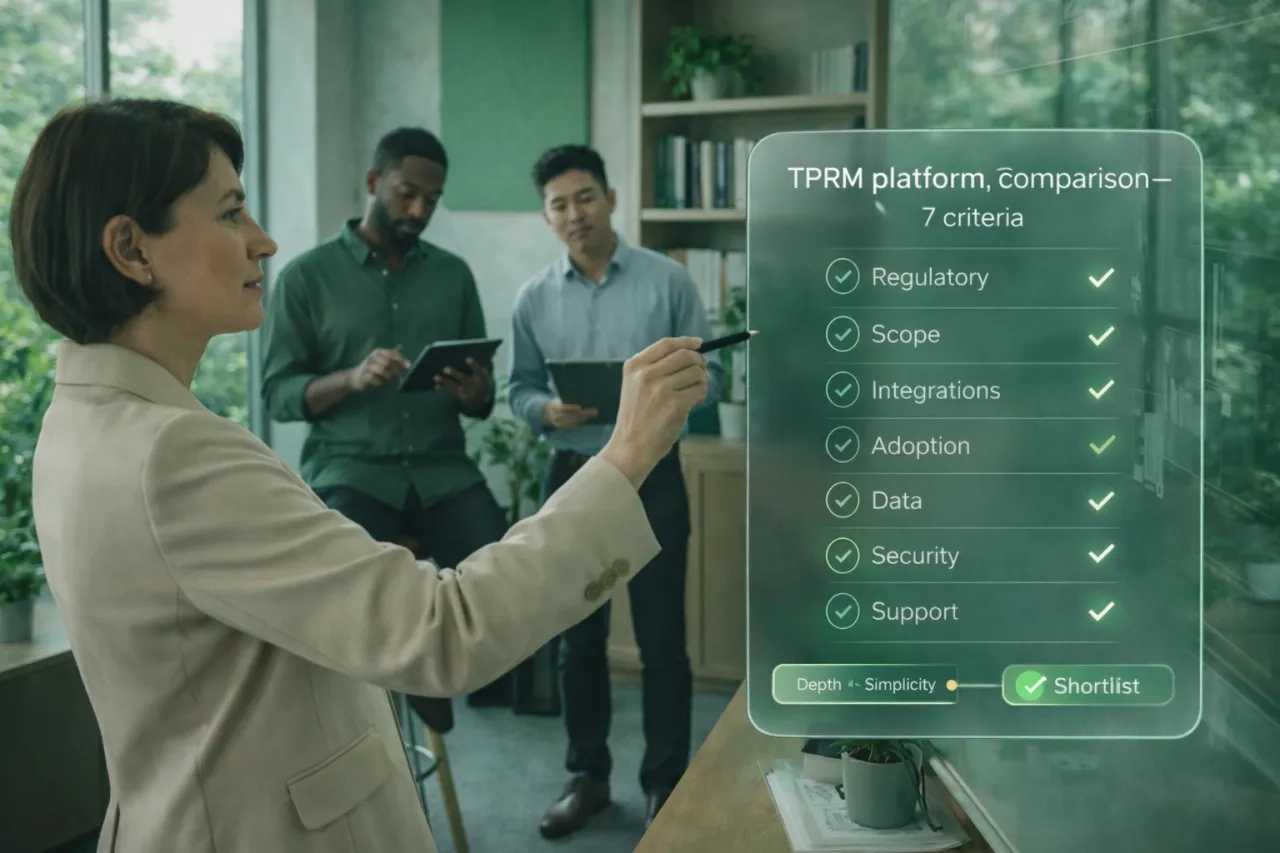 15 January 2026TPRM platforms in Europe: 7 selection criteriaTPRM&TPGRCQuick answer: TPRM platforms in Europe are typically compared on more than feature coverage. A robust selection process checks regulatory alignment (GDPR, NIS2, DORA, CSRD), proportional controls by third-party criticality, and adoption by both internal teams and suppliers. In large deployments, platforms designed as a single system of record for third-party governance have been associated […]
Read more
-
 23 March 2026TPRM ownership: who should own third-party risk management?TPRM&TPGRCTPRM ownership is rarely a single-team decision. In most organisations, the most resilient model assigns Procurement an operational lead for supplier onboarding, gives IT and security clear authority to validate cyber risk, and uses Compliance and Risk governance to set policy and reporting. Platforms like Aprovall support this operating model at scale for 1,800+ customer […]
Read more