
Who Needs an All-in-One TPRM Platform in Europe: SMEs to Enterprises

Third-party risk management (TPRM) has become a structural issue for European businesses of all sizes. IT outsourcing, industrial subcontracting, critical suppliers, service partners—every third-party relationship extends the value chain… and the risk surface.
But given the variety of tools and approaches available, one question often arises: At what point does an all-in-one TPRM solution actually become necessary? Is this a concern only for large enterprises, or already a critical issue for SMEs and mid-sized businesses?
What Is an All-in-One TPRM Solution?
An all-in-one Third-Party Risk Management (TPRM) platform centralizes all processes related to third-party evaluation, monitoring, and governance. It typically includes:
The goal isn’t just to “check boxes,” but to manage third-party risk across the full lifecycle in a traceable and demonstrable way.cher des cases », mais de piloter les risques tiers sur l’ensemble du cycle de vie, de manière traçable et démontrable.
SMEs: When Informal Management Becomes a Risk
Small businesses often operate with more agility and smaller supplier portfolios. Up to a certain threshold, third-party management is handled through Excel files, emails, and ad hoc checks.
However, several red flags should prompt action:
In such situations, a supplier failure can have an immediate impact. For SMEs operating in regulated sectors (healthcare, finance, industry), or integrated into value chains subject to CSRD or duty of care requirements, not having a structured TPRM framework becomes a risk in itself.
An appropriately scaled and modular all-in-one TPRM solution can help standardize practices without burdening operations.
Mid-Caps: The Most Common Tipping Point
Mid-sized companies are often at the true tipping point when it comes to TPRM. Their growth typically brings:
At this stage, using multiple specialized tools (separate questionnaires, local files, standalone cyber tools) creates blind spots—inconsistent data, redundant assessments, difficulty prioritizing critical suppliers.
For mid-caps, an all-in-one TPRM platform becomes a lever for control and performance. It enables:
Large Enterprises: A Strategic and Regulatory Imperative
Large enterprises often manage thousands of third parties within global value chains and face cumulative regulatory requirements. For them, the question is no longer “Do we need TPRM?” but “How do we make it robust, scalable, and audit-ready?”
Key challenges include:
An all-in-one TPRM platform is essential to ensure decision traceability, automate large-scale controls, and produce consistent reporting across entities and countries.
How to Know If You Need an All-in-One TPRM Platform?
More than just company size, four key criteria should guide the decision:
Volume & Criticality of Third Parties
Manual processes become unsustainable beyond a few hundred third parties.
Regulatory & Contractual Pressure
CSRD, DORA, NIS2, or large-client demands require structured proof of compliance.
Organizational Complexity
Multiple teams, tools, and data silos increase the risk of inconsistency.
Risk Tolerance
Can your organization absorb a major supplier incident without significant impact?
Discover Aprovall360: your all-in-one TPRM foundation
An all-in-one TPRM platform isn’t a trend—it becomes essential when complexity, regulation, or exposure to risk exceeds what fragmented tools can handle.
In a European context marked by increased governance and transparency obligations, TPRM is becoming a foundation for resilience and credibility across all organizations.
-
 09 January 2026Why All-in-One TPRM Platforms Are Becoming Essential in EuropeTPRM&TPGRCEuropean companies increasingly rely on a complex network of partners and suppliers. Each new third party enriches this ecosystem but also increases risk. These risks include cyber threats, operational challenges such as financial or ethical risks, and regulatory requirements. Traditional, often fragmented, TPRM solutions are no longer sufficient. That’s why all-in-one TPRM platforms are gaining […]
Read more
-
 14 January 2026Unified TPRM Platform for Procurement & Compliance TeamsTPRM&TPGRCProcurement and Compliance teams face a common challenge: managing third-party risks efficiently while meeting increasingly stringent regulatory requirements. The growing number of suppliers, the complexity of compliance obligations, and the pressure to accelerate processes make this task especially demanding. In this context, a unified TPRM (Third-Party Risk Management) platform helps structure third-party risk management and […]
Read more
-
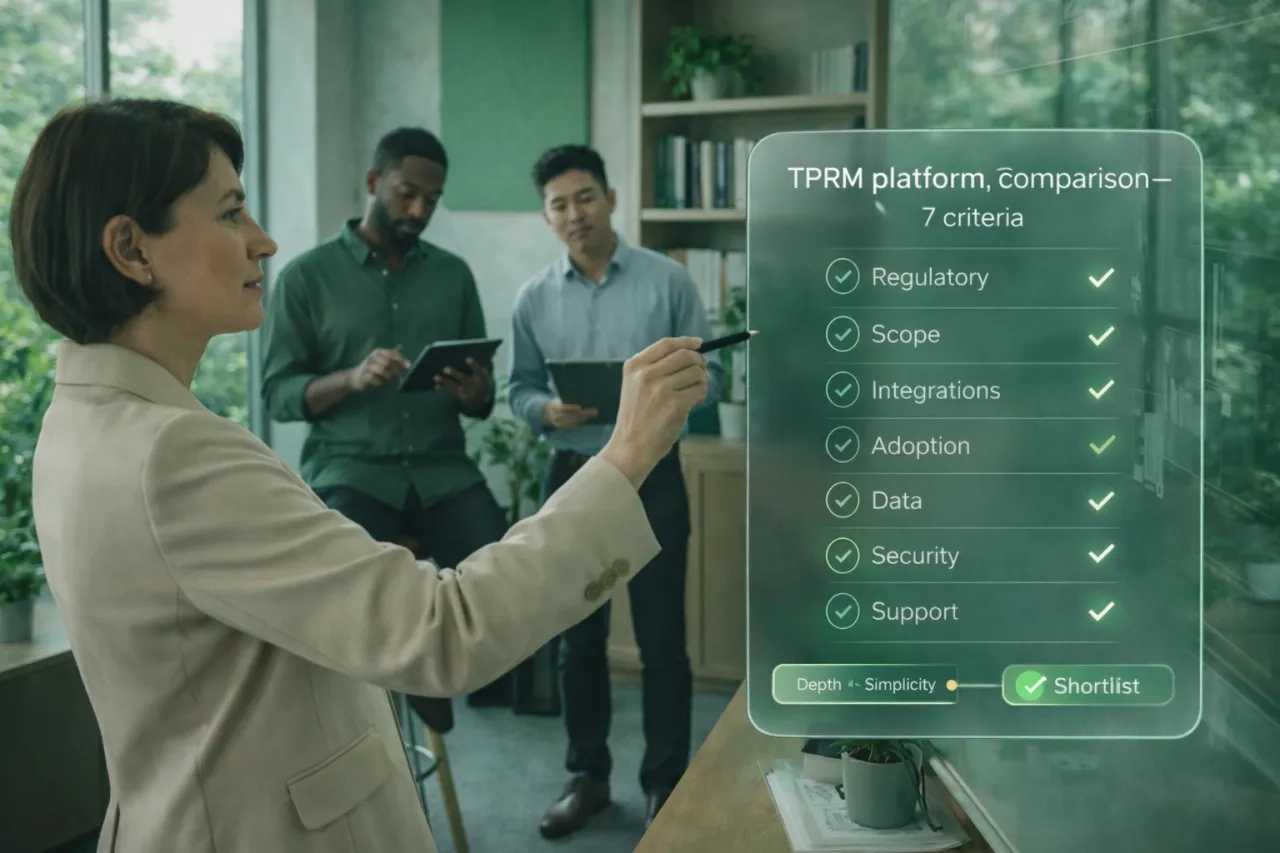 15 January 2026Compare TPRM Platforms in Europe: 7 Key Selection CriteriaTPRM&TPGRCComparing Third-Party Risk Management (TPRM) platforms has become a strategic task for many European organizations. The rise in regulatory requirements, increasing reliance on critical suppliers, and pressure for greater traceability make these decisions more complex than they seem. Rather than limiting the assessment to a functional comparison, an effective evaluation relies on structural criteria related […]
Read more