Third-Party Cybersecurity Benchmark: Assessing and Securing Your Supply Chain in 2025
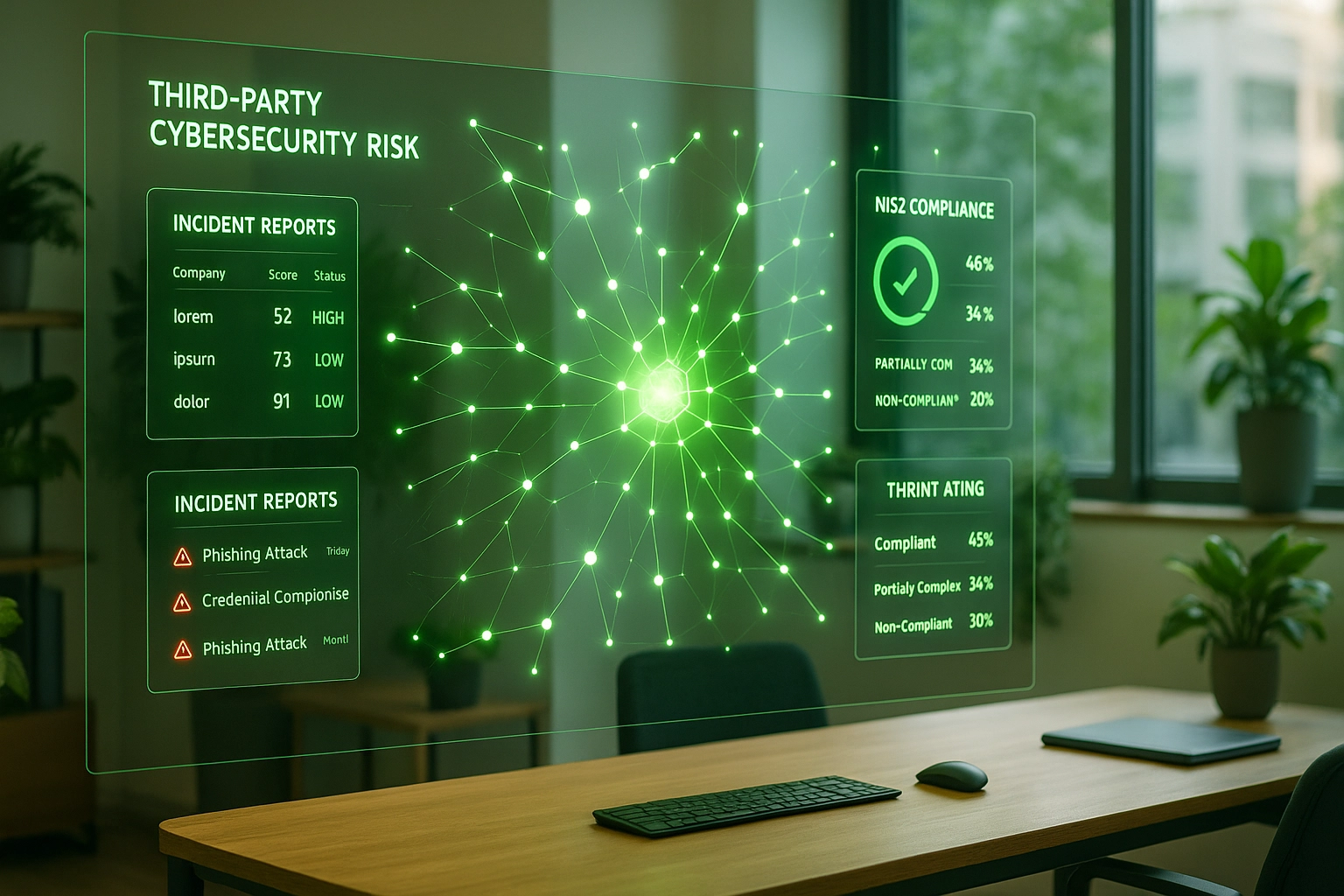
Third-party cybersecurity has become a major strategic concern for organizations in 2025. According to AgileBuyer, 65% of procurement departments consider supplier failures a critical risk, while 42% list cyberattacks as their second most pressing concern.
This challenge is especially acute in certain sectors: 88% of heavy industries anticipate major supplier-related risks, and 68% of IT/Telecom companies rank cyber risks as a top priority.
The domino effect of a cyberattack on a key supplier can wreak havoc across the entire supply chain. In response, assessing the cyber maturity of third-party partners is now essential. Collaboration helps identify vulnerabilities and strengthen the operational resilience of the entire ecosystem.
How to Conduct a Third-Party Cybersecurity Benchmark
A third-party cybersecurity benchmark is a strategic initiative to assess and secure your supply chain. This methodology helps identify and manage partner-related risks. 54% of large organizations now cite supply chain vulnerabilities as the main obstacle to cyber resilience.
TPRM-Oriented Definition
Evaluating supplier cyber maturity requires a comprehensive approach that includes technical, organizational, and regulatory aspects. NIST defines cyber supply chain risk as “the potential harm arising from suppliers, their supply chains, their products, or their services.”
Technological Differentiators
The growing complexity of digital ecosystems requires advanced evaluation tools.
An effective third-party risk management program must include:
- A comprehensive inventory of third-party relationships
- A risk categorization per supplier
- Ongoing assessments based on objective indicators
Sector-Specific Challenges
Benchmarking requirements vary significantly by industry:
- Retail must manage risks related to international marketplaces and multi-country e-commerce compliance.
- The financial sector, subject to DORA, must deeply assess critical IT service providers.
- Local governments must ensure transparency and qualify public procurement participants.
Collaborative evaluations help identify sector-specific vulnerabilities. Shared intelligence leads to more relevant risk analysis and optimized third-party monitoring.
Cybersecurity Standards and Frameworks
Assessing third-party cyber maturity relies on recognized frameworks. This ensures an objective evaluation and aligns with emerging regulations like NIS 2, affecting over 150,000 European entities.
International Standards
The ISO 27001:2022 standard defines 93 control measures across three categories: preventive, detective, and corrective. It is a must-have for assessing the robustness of critical supplier protection systems—especially in the public sector where safeguarding sensitive data is essential.
European Regulations
The NIS 2 directive sets a unified cybersecurity framework across 18 critical sectors, with a strong focus on supplier evaluation. Affected organizations must:
- Implement cyber supply chain risk governance
- Regularly assess critical partners
- Continuously monitor third-party security posture
Sector-Specific Certifications
Industrial sectors require certifications like IEC 62443 for automation system security. This standard defines four Security Levels (SL1 to SL4) tailored to the criticality of ICPE installations.
Third-Party Assessment Focus
Standards help structure supplier evaluations around:
- Data/system criticality
- Maturity level required per industry
- Applicable regulatory requirements
This standardized approach strengthens the entire value chain, especially as 42% of procurement leaders view cyber risk as a major concern.
Cyber Maturity Assessment Methodology
Evaluating third-party cyber maturity requires a structured methodology combining quantitative and qualitative analysis. This approach offers a clear view of critical partners’ protection levels.
Collaborative Evaluation Process
Third-party risk scoring is based on an automatic, statistical model integrating:
- Asset and access inventory
- Technical vulnerability analysis
- Governance and process assessment
- Certification and compliance monitoring
Evaluation Criteria
Risk scores are calculated using a matrix combining the likelihood and potential impact of threats, enabling organizations to:
- Quantify risk levels objectively
- Prioritize remediation actions
- Tailor controls based on supplier criticality
Intelligent Workflows
Automated assessment tools streamline the process while ensuring:
- Standardized questionnaires
- Systematic verification of provided evidence
- Continuous monitoring of key risk indicators
Sectoral Illustrations
Evaluation criteria are customized per industry:
- Manufacturing focuses on industrial control system protection and ICPE compliance
- Public sector prioritizes GDPR and citizen data security
- Construction emphasizes subcontractor certification and HSE site compliance
This methodology, tested on over 430,000 third parties, identifies sectoral vulnerabilities and strengthens overall ecosystem protection.
Explore our collaborative evaluation approach and leverage workflows validated by 85% of auditors.
Continuous Third-Party Monitoring: Securing the Supply Chain
Continuous third-party monitoring is essential for supply chain risk governance. A proactive approach helps identify and respond swiftly to emerging threats, as 86% of companies faced a cyberattack in 2024.
Technological Solutions
Automated monitoring of critical partners relies on:
- Real-time configuration and vulnerability analysis
- Behavioral anomaly detection
- Multi-source security alert tracking
- Continuous risk scoring
Operational Benefits
Continuous monitoring improves value chain protection through:
- Early detection of security incidents
- Ongoing regulatory compliance checks
- Follow-up on corrective actions
- Dynamic adaptation of control levels
Sector Focus
In manufacturing, real-time monitoring of critical systems ensures prompt detection of potential compromises. In the public sector, the focus is on continuous protection of sensitive data and GDPR compliance.
Performance Indicators
Monitoring effectiveness is measured via KPIs such as:
- Mean Time to Detect (MTTD)
- Mean Time to Resolve (MTTR)
- Compliance rate with standards
- Third-party risk scores
Permanent monitoring, combined with smart workflows and AI-based documentation analysis, significantly boosts ecosystem resilience.
Aprovall integrates multiple technologies to identify cyber risks among subcontractors and suppliers—from cyber risk scoring to media intelligence.
Conclusion
Cyber supply chain risk governance is a strategic pillar for organizations in 2025. With 42% of procurement leadersciting cyberattacks as a top concern, evaluating third-party cyber maturity is a must.
A structured benchmark approach delivers three key benefits:
- Increased visibility into supply chain vulnerabilities
- Resource optimization through AI and automation
- Improved compliance with new regulations like NIS 2 and DORA
For the IT/Telecom sector in particular—where 68% of businesses consider cyber risk a top priority—collaborative evaluation combined with continuous monitoring is vital for business continuity. This approach not only ensures compliance but also secures critical systems.
Assess your cyber supply chain maturity for free and benefit from our expertise based on 430,000+ evaluated third parties.
-
 12 May 2025Understanding the Impact of the NIS 2 Directive on the Supply ChainSecteurThe modern supply chain forms the backbone of European economies, orchestrating complex flows between partners, suppliers, and subcontractors. With the acceleration of digitalization, this growing interconnection exposes organizations to unprecedented cyber vulnerabilities. The NIS 2 directive, effective since October 2024, is revolutionizing the cybersecurity approach by mandating collaborative evaluation of third-party partners. This regulatory shift […]
Read more
-
 23 June 2025How to Select Priority KPIs or KRIs for Third-Party MonitoringSecteurIn third-party governance, tracking key performance indicators (KPIs) has become a central component in meeting rising expectations for operational resilience. Operations managers and compliance officers now expect dynamic dashboards that clearly rank the risks associated with each third-party partner while taking into account industry specifics and risk profiles. According to a Grant Thornton study, only 45% […]
Read more
-
 26 September 2025How to Identify Risks Across Your Entire Supply ChainSecteurAs supply chains grow more complex and geographically dispersed, companies can no longer afford to assess only their direct suppliers. Major risks—whether related to cybersecurity, corruption, or production continuity—can emerge much deeper in the chain. A single raw material supplier at tier 8 can jeopardize an entire production line. This is why expanding risk assessments […]
Read more
-
 10 February 2025How TPRM and TPGRC Solutions Are Transforming the Retail and Distribution Sector in 2025SecteurThe retail and distribution sector plays a crucial role in the French economy, orchestrating a vast network of subcontractors and suppliers. These stakeholders contribute to both supply chain management and the final customer experience. Among them, installers and delivery partners represent critical links in the value chain. However, this sector faces major challenges: ensuring subcontractor […]
Read more