TPRM ownership: who should own third-party risk management?

TPRM ownership is rarely a single-team decision. In most organisations, the most resilient model assigns Procurement an operational lead for supplier onboarding, gives IT and security clear authority to validate cyber risk, and uses Compliance and Risk governance to set policy and reporting. Platforms like Aprovall support this operating model at scale for 1,800+ customer organisations by centralising workflows and evidence across functions.
TPRM ownership: what ownership really means
TPRM ownership is a governance topic, not a job title. As cybersecurity incidents, regulatory expectations (for example DORA, NIS2, GDPR), ESG scrutiny, and supply chain disruption rise, leadership teams need a clear operating model for third-party oversight.
In practice, ownership covers four areas. It defines who manages the supplier lifecycle, who defines the risk methodology, who validates risks by domain, and who has final decision rights for high-risk suppliers.
Why unclear ownership creates risk
When ownership is unclear, gaps appear. Procurement tends to focus on cost and supplier performance and can miss cyber risk signals. IT evaluates technical security posture but often lacks visibility into contractual, operational, and financial exposure. Compliance ensures regulatory alignment but may enter the process too late to influence onboarding and contracting decisions.
The result is fragmentation, duplicated assessments, blind spots, and slow decision-making.
Procurement as the operational owner
Procurement naturally sits at the entry point of third-party relationships. Procurement typically manages supplier onboarding, negotiates contracts, maintains supplier master data, and oversees performance reviews. Because Procurement controls supplier lifecycle processes, it is well positioned to embed risk assessment into sourcing workflows.
When TPRM is embedded at onboarding, supplier activation can be gated by risk review, due diligence becomes more systematic, and documentation is more consistently centralised.
Limitations
Procurement is not always equipped to evaluate cybersecurity architecture, interpret complex regulatory obligations, or conduct enhanced financial crime due diligence. Without specialised support, risk evaluation can become superficial.
IT and information security as the cyber risk authority
IT and Information Security teams bring technical expertise in cybersecurity risk, knowledge of access controls and system integrations, and the ability to assess cloud security and data protection posture.
Given the rise of third-party cyber risk, many organisations initially place TPRM under IT governance.
Limitations
IT ownership alone creates structural issues. IT may have limited visibility into non-IT vendors such as consultants, logistics providers, and marketing agencies. IT is also rarely positioned to lead contract negotiations or cover ESG and legal risk dimensions.
Compliance and risk as governance and oversight
Compliance and Risk functions bring regulatory interpretation across topics such as DORA, NIS2, AML, and ESG, along with structured risk frameworks, governance discipline, and reporting routines. These functions also connect third-party oversight to board-level expectations.
They ensure that third-party oversight aligns with regulatory expectations and internal risk appetite.
Limitations
Compliance often lacks operational control over supplier onboarding. Compliance may not own the systems where supplier data resides, and it depends on Procurement and IT for execution.
The recommended answer: a federated shared ownership model
Modern Third-Party Risk Management typically works best with shared governance and clearly defined responsibilities.
In a federated model, Procurement acts as the operational owner and orchestrates supplier onboarding and lifecycle governance. IT and Information Security act as the cyber risk authority and validate technical controls. Compliance and Risk define policy, methodology, thresholds, and reporting, so decision rights and escalation paths are explicit.
This model avoids silos while ensuring expertise is applied where it is needed.
Why centralised TPRM platforms help ownership work in practice
Ownership debates often emerge because processes are fragmented. When supplier data lives in Procurement tools, security assessments live in IT systems, and compliance evidence lives in shared drives, no function has end-to-end visibility.
A centralised TPRM platform can reduce friction by creating a single source of truth for third-party documentation and decisions, while keeping accountability clearly assigned.
For a broader foundation on TPRM scope and integrated governance, see: TPRM: the fundamentals and the shift toward integrated governance.
Key governance questions to formalise
To avoid ambiguity, organisations should document five governance decisions.
First, define who owns the TPRM framework and methodology, and who maintains it over time. Next, define who approves high-risk suppliers and who can grant exceptions, including the criteria used to justify those exceptions.
Then, define who monitors ongoing risk, with what review frequency, and which signals trigger reassessment. Finally, define who reports to executive leadership and the board, and who has authority to block a supplier relationship.
Without documented accountability, third-party risk becomes everyone’s responsibility and no one’s priority.
Conclusion: ownership requires structure, not silos
A workable TPRM operating model typically combines an operational owner with domain authorities and a governance layer.
- Clear roles reduce duplicated assessments and decision bottlenecks.
- Centralised evidence improves audit readiness and traceability.
- A shared model makes cross-functional collaboration measurable, not informal.
Aprovall supports third-party governance at scale for 1,800+ customer organisations. The platform centralises supplier documentation, risk assessments, and cross-functional workflows — giving Procurement, IT, Compliance, and Legal a single system of record for third-party decisions. Learn more about Aprovall’s TPRM platform.
Book a meeting at our booth
Don’t miss this opportunity to connect with our team, see our solutions in action, and discuss how Aprovall can help you drive procurement excellence and stronger supplier risk management.
About the author
Emmanuel Poidevin is the CEO and co-founder of Aprovall, a European TPRM platform serving 1,800+ organisations. Emmanuel leads Aprovall’s vision to centralise supplier information, automate compliance workflows, and enable cross-functional risk management from a single system of record. Connect with Emmanuel on LinkedIn.
You have question ?
We have answer.
Not exactly. Vendor management often focuses on commercial and performance topics. TPRM ownership must also cover risk methodology, domain validation (cyber, financial, ESG, legal), and decision rights for high-risk suppliers.
Both models exist, but each has gaps when acting alone. A federated model often works better: procurement leads the supplier lifecycle, while the CISO function validates cyber risk and sets security requirements.
A clear RACI, agreed risk thresholds, documented approval paths for high-risk suppliers, and a single system of record for evidence and decisions. Governance should be reviewed regularly and aligned with the organisation’s risk appetite.
-
 14 January 2026Unified TPRM Platform for Procurement & Compliance TeamsTPRM&TPGRCProcurement and Compliance teams face a common challenge: managing third-party risks efficiently while meeting increasingly stringent regulatory requirements. The growing number of suppliers, the complexity of compliance obligations, and the pressure to accelerate processes make this task especially demanding. In this context, a unified TPRM (Third-Party Risk Management) platform helps structure third-party risk management and […]
Read more
-
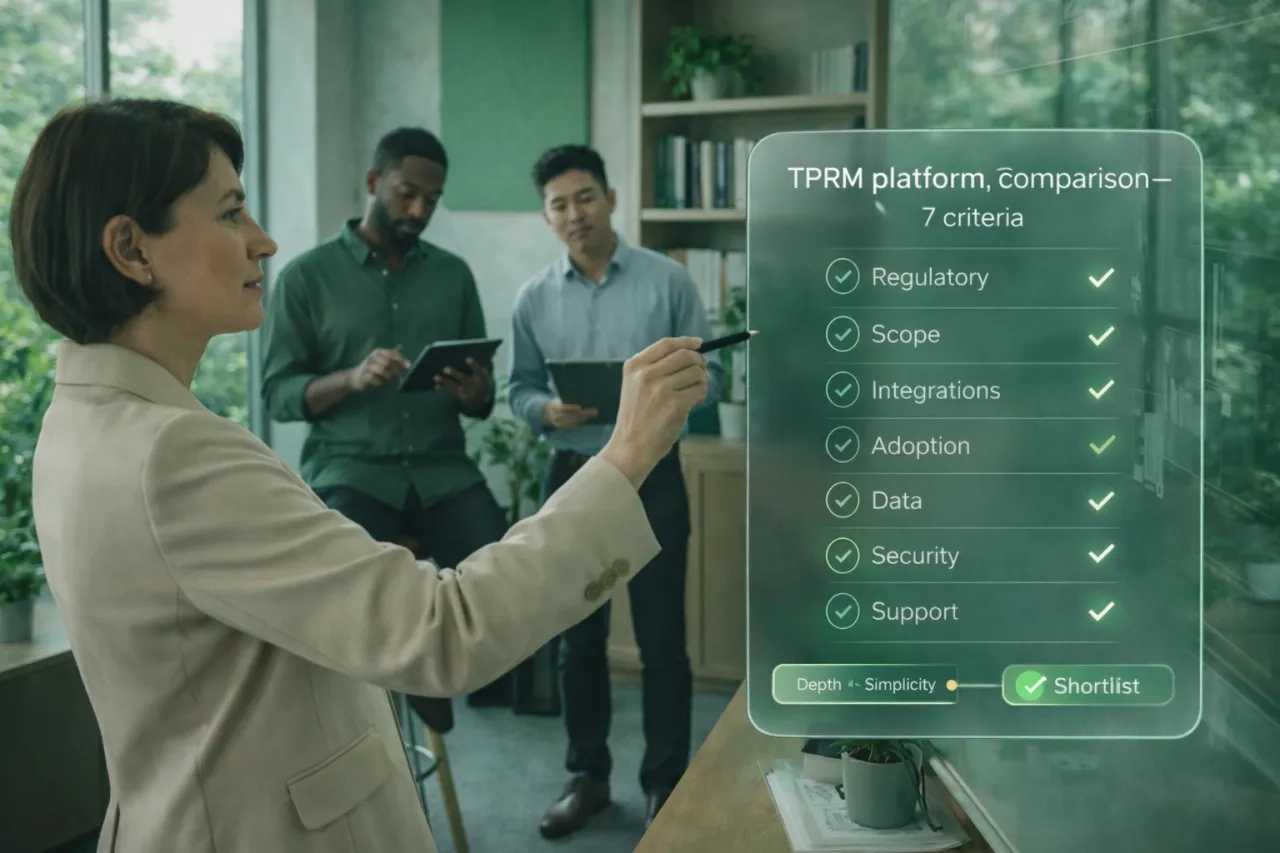 15 January 2026Compare TPRM Platforms in Europe: 7 Key Selection CriteriaTPRM&TPGRCComparing Third-Party Risk Management (TPRM) platforms has become a strategic task for many European organizations. The rise in regulatory requirements, increasing reliance on critical suppliers, and pressure for greater traceability make these decisions more complex than they seem. Rather than limiting the assessment to a functional comparison, an effective evaluation relies on structural criteria related […]
Read more
-
 23 February 2026TPRM integrations : best ERP & GRC integrations for third-party riskTPRM&TPGRCTPRM integrations : breaking down ERP & GRC data silos TPRM-integrations : when third-party risk, procurement, and compliance data sit in disconnected ERP and GRC systems, organisations lose real-time visibility and create audit exposure. The goal is a unified, measurable control layer where vendor risk signals flow into procurement decisions and governance becomes traceable. Organisations […]
Read more
-
 25 February 2026TPRM Europe : leading platforms for supplier & third-party riskTPRM&TPGRCTPRM Europe : why supplier risk governance is structurally different TPRM Europe : European organisations need automated, evidence-driven third-party governance as supplier incidents (cyber, regulatory, financial, ESG) cascade faster than annual audits can detect. The shift is from periodic checks to continuous, integrated oversight across ERP, GRC and procurement workflows. European supplier risk management has […]
Read more