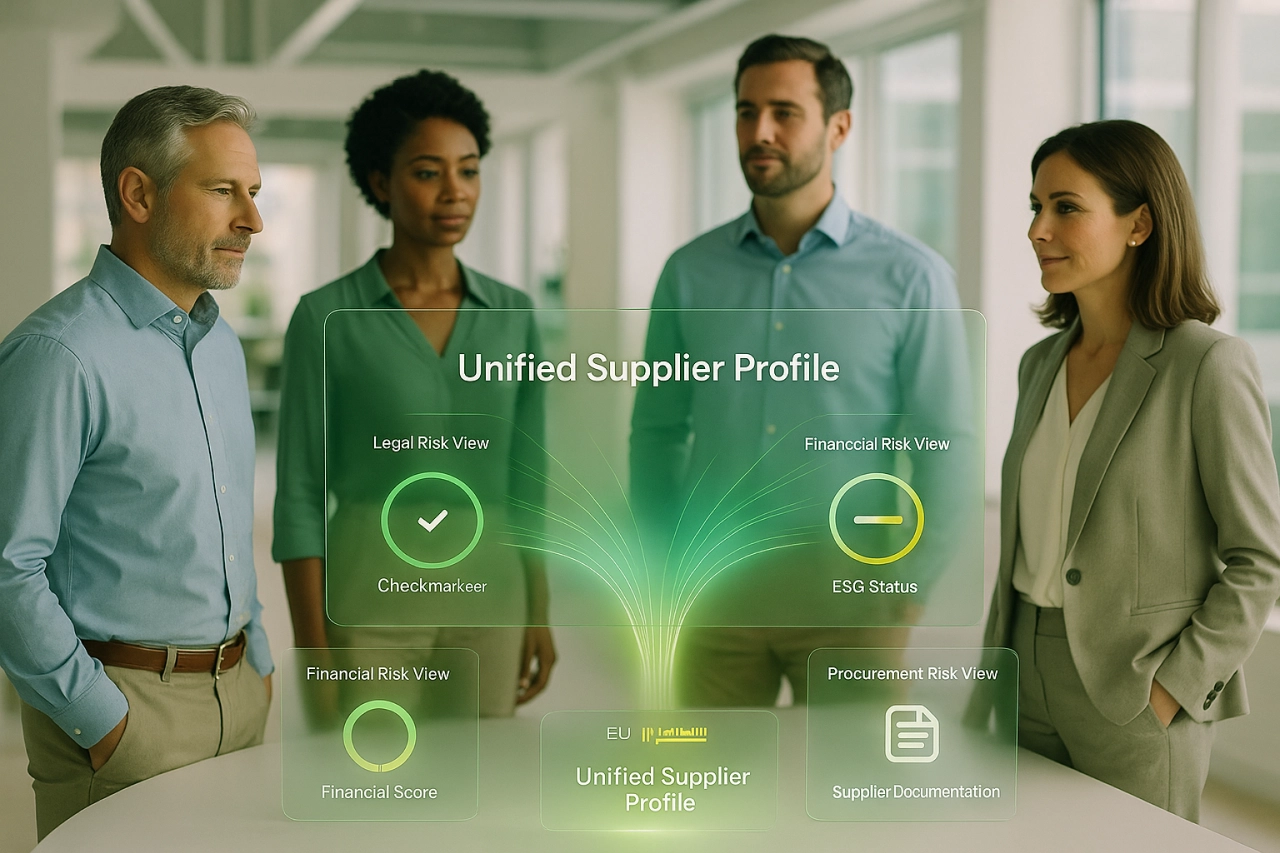
Understanding Key Financial Indicators for Evaluating Your Third-Party Partners

In an economic environment where over 60% of European companies have faced operational incidents linked to their third-party partners, as highlighted by the European Central Bank in its Annual Report on Supervisory Activities, understanding and mastering key financial indicators has become essential for evaluating the stability of your business partners. These third-party assessment tools help quickly identify potential risks and make informed decisions about your business relationships—whether with suppliers, subcontractors, or service providers.
Analyzing the critical financial parameters of your external partners is no longer just about checking their economic health—it’s now part of a broader third-party governance and operational resilience strategy. This shift transforms financial due diligence into a strategic pillar of risk management.
Why Financial Indicators Are Essential for Evaluating Third-Party Partners
The AgileBuyer study reveals that in 2025, Procurement Departments rank the risk of financial failure as the top concern. In parallel, Altares D&B has reported a 17% increase in business failures in 2024 and 4.4% in Q1 2025.
Thus, the financial assessment of your partner ecosystem is not just about economic health; it’s also about governance and adaptability. In an increasingly demanding regulatory context, the prior screening of financial data becomes central to your risk management strategy.
Revenue Analysis: More Than Meets the Eye
A third-party partner’s revenue is a key starting point in a risk assessment process. But this indicator must be thoroughly analyzed to understand its real implications. For instance, in the construction sector, a sudden revenue spike in a subcontractor may conceal excessive risk-taking in unfamiliar markets—jeopardizing their ability to meet commitments.
Reviewing revenue trends over several fiscal years, analyzing breakdowns by business activity, and identifying client concentration are crucial to assess a third party’s stability and their capacity to sustain long-term business relationships in your supply chain.
Insights from Altares D&B
Financial analysis provides powerful indicators for shaping the right strategy with your third parties. However, this data can be incomplete or inaccessible and may require additional sources.
At Altares D&B, financial analysis is a key asset in building the failure score (rating). The indicators used to calculate this score vary by industry and company size. Confidential balance sheets (more than 70% of published balance sheets) are used to build Altares-D&B’s scores.
Altares D&B draws on over 900 sources, offering access to data such as payment behavior toward suppliers, legal events, and other so-called “weak signals.” The integration of these data sources—enhanced by Artificial Intelligence tools—ensures high-performing indicators to support confident decision-making.

Gilles Lambert – Product Marketing Manager, Finance Solutions | Altares D&B
Analyzing Margins: Gross and Net Profitability
Margin analysis is a fundamental pillar of your third-party financial assessment. According to PwC Viewpoint, reviewing gross margins reveals a supplier’s ability to generate profits from core activities—an essential indicator of operational viability.
In construction, for instance, a gross margin below 15% may signal a subcontractor’s risk of failure, as Bridgit Bench notes in its sector financial ratio analysis. Evaluating this ratio helps anticipate cash flow tensions that could disrupt service continuity.
The net margin offers a broader view of a partner’s overall financial health. A gradual decline over several years is a serious red flag that warrants deep due diligence.
Break-Even Point: Identifying Vulnerabilities
A third party’s break-even point is a key risk indicator in your collaborative evaluation process. As Accountancy Cloud explains, “break-even analysis plays a critical role in evaluating revenue-related risk levels,” helping identify a supplier’s vulnerability to market fluctuations.
For industrial players, a high break-even point relative to revenue indicates low financial flexibility and increased exposure to demand variation—potentially threatening your supply chain’s operational resilience.
Optimize your third-party financial assessment
Discover how Aprovall360 can help you automate the analysis of key financial indicators and anticipate risks before they impact your value chain.
Evaluating Third-Party Cash Flow and Liquidity
Assessing your external suppliers’ cash flow is fundamental to your financial due diligence process. As FreeBalance emphasizes, “identifying and evaluating financial risks that could impact funding” is essential for anticipating potential failures in your value chain.
In distribution, a supplier’s ability to convert assets into cash quickly is crucial for ensuring supply continuity. According to Allianz Trade, “liquidity risk occurs when a company cannot turn assets into cash fast enough to meet obligations”—a major early warning sign in third-party governance.
Working Capital and Working Capital Requirements
A supplier’s working capital (FRNG) and working capital requirements (WCR) reveal their ability to finance operations without emergency solutions. As Maxicours explains, working capital represents “the surplus of stable resources used to finance operations,” a key indicator of a partner’s financial solidity.
In the construction sector, analyzing the WCR is particularly revealing. As EBP notes, effective cash flow management is “crucial to avoid liquidity shortages” that could compromise projects—and long-term operations.
Operating Income and Profitability: Measuring Efficiency
Operating income is a decisive indicator in your suppliers’ financial evaluation. According to Propulse, “operating income measures business performance” and reflects whether a company’s business model is profitable. A positive result shows the partner generates sufficient operating profit to meet financial obligations, while a negative result signals operating loss and increased failure risk.
In distribution, analyzing the operating margin ratio (Operating Income / Net Sales × 100) assesses a supplier’s operational efficiency and their ability to stay competitive while remaining viable. A consistently declining margin is a major red flag in your due diligence process.
Risk Management Through Third-Party Evaluation
Supplier risk management requires a structured approach to individualized third-party evaluation. This means “mapping all third parties involved with the organization and classifying them according to risk profiles.”
Given that 38% of companies have faced major disruptions from third-party partners over the past three years (as discussed in a previous article), collaborative evaluation is emerging as a strategic alternative to traditional audits. This approach is based on six core areas of expertise, including financial stability—allowing early detection of potential failures before they affect your value chain.
In the public sector, this methodology is especially relevant for public contracts, where provider failures can have serious legal and operational consequences.
Using Financial Indicators to Drive Growth
L’utilisation stratégique des indicateurs financiers dans l’évaluation de l’écosystème partenaire constitue un levier de The strategic use of financial indicators in evaluating your partner ecosystem is a powerful lever for growth.
In the public sector, analyzing strategic financial KPIs helps anticipate failure risks and ensure continuity of essential services. This approach is part of broader third-party governance, where financial evaluation becomes a foundation of operational stability.
According to Legalstart, these KPIs “assess financial balance, profitability, and financial independence”—all crucial to assessing a business partner’s long-term reliability. majeur pour les organisations.
Comparative Table: Financial KPIs by Key Sector
| Sector | Key Indicators | Alert Thresholds |
|---|---|---|
| Construction | Gross Margin Working Capital Requirement (WCR) Quick Ratio | < 15% > 25% of revenue < 0,8 |
| Industry | Margin Rate Investment Rate Value Added Rate | < 27,9% < 23,6% < 21,2% |
| Distribution | Profit Margin Rate Value Added Rate Investment Rate | < 31,3% < 15,8% < 11,4% |
| Public Sector | Average Incident Resolution Time Compliance Rate Critical Dependency | 30 days < 90% 25% of total purchases |
Implementation and Ongoing Monitoring
Implementing a third-party financial evaluation process requires a structured and evolving approach. As Appvizer recommends, indicators should be presented in dashboard form to be evaluated “over time—to track changes across periods,” and “comparatively—to benchmark results against competitors.”
In the distribution sector, this methodology helps quickly detect suppliers showing financial warning signs, such as declining margins or a sudden rise in working capital needs. Integrating these financial indicators into a continuous due diligence process transforms periodic checks into a real partner management tool.
To maximize effectiveness, it’s advisable to track a limited set of around 10 indicators—focused on those most relevant to your sector and third-party risk strategy.
Turning Third-Party Financial Assessment into a Strategic Advantage
Your suppliers’ financial evaluation is far more than a mere administrative task—it’s a key pillar of your operational resilience. As shown, each key financial indicator uncovers a unique aspect of a partner’s economic health, helping you anticipate risks before they impact your value chain.
Turning this data into actionable insight requires a structured, sector-specific approach. With a base of over 450,000 third parties globally, Aprovall has developed unique expertise in collaborative partner evaluation, combining deep financial analysis with understanding of industry-specific challenges.
By integrating these essential financial ratios into a holistic TPGRC (Third Party Governance & Risk Compliance) approach, you don’t just manage risk—you turn your due diligence process into a real competitive edge, ensuring long-term performance and resilience across your partner ecosystem.
Strengthen your operational resilience through collaborative evaluation
Aprovall supports you in implementing effective third-party governance, integrating financial analysis into a complete TPGRC strategy.
-
 21 April 2025NIS2: Understanding the Obligations of Critical SuppliersSolutionsThe NIS2 Directive redefines cybersecurity requirements for critical entities and their third-party governance across Europe. With over 1.8 million companies indirectly affected via their supply chains (NIS2 Quality Mark – 2025), identifying critical third parties is now a strategic imperative for key sectors like construction and public services. This regulation mandates a dynamic mapping of […]
Read more
-
 19 January 2025Aprovall’s Strategic Challenges under CSRDSolutionsFor Aprovall, which supports over 430,000 third-party partners across Europe, operational resilience is a major strategic priority. A recent study reveals that 55% of companies subject to CSRD face difficulties in managing data quality and consistency. In response, Aprovall’s dual ISO 27001/27701 certification provides a robust framework for ESG data governance. In the social housing sector, sustainable performance requires an integrated value chain […]
Read more
-
 14 February 2025Supply Chain and Cyber Risks: How to Protect Your Supply Chain?SolutionsThe digital transformation of supply chains creates new opportunities but also exposes organizations to growing vulnerabilities. In 2025, third-party compliance assessment and management becomes a major strategic issue as 45% of global organizations will have suffered supply chain attacks, three times more than in 2021. Given this shift, third-party governance has become a top priority, especially in critical sectors such as […]
Read more
-
 05 December 2025Breaking Down Silos: How TPRM Unifies Supplier Risk EvaluationSolutionsIn today’s economy, dependence on third parties—suppliers, service providers, partners—is both a source of value and risk. Evaluating and managing these risks is no longer optional; it’s essential for security, compliance, and business continuity. Yet one major internal barrier continues to slow down these critical processes: organizational silos. The Trap of Internal Silos Third-Party Risk […]
Read more