ESG platforms: centralized data for sustainable performance
The growing interest of investors and businesses in Environmental, Social, and Governance (ESG) criteria comes with significant challenges in assessing third-party partners. According to the DLA Piper report, ESG evaluation of external providers has become critical, particularly with the CS3D directive (Corporate Sustainability Due Diligence), which entered into force on July 25, 2024. It requires large companies to identify and address adverse human rights and environmental impacts in their own operations and across their value chains.
As regulatory demands increase, the fragmented solutions still widely used today are showing their limits: without a single ESG platform, third-party compliance analysis stays incoherent and inefficient.
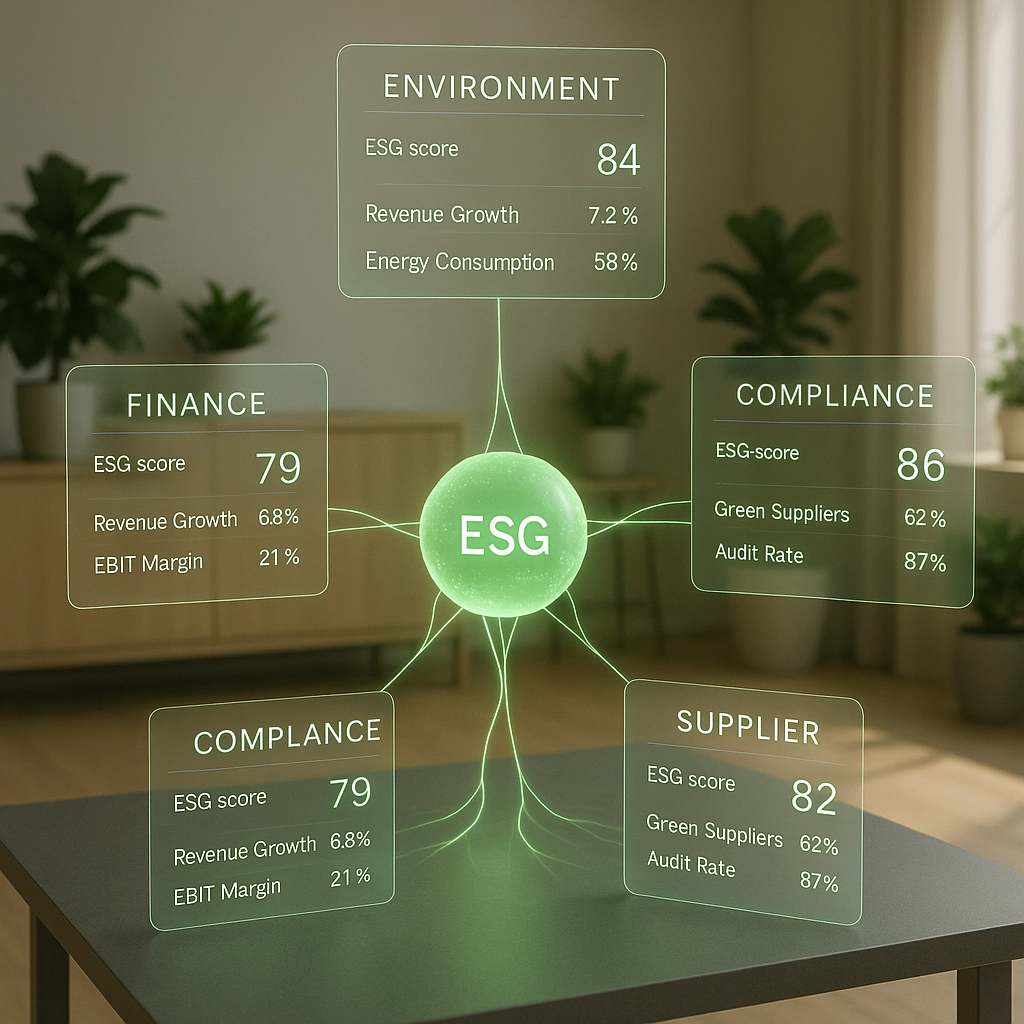
This is where a centralized ESG platform becomes essential, offering significant advantages in regulatory compliance, cooperative third-party verification, and integrated reporting. This approach not only enhances third-party risk management, but also helps build operational resilience in an environment where ESG requirements are rapidly evolving. For the wider picture of what ESG now demands from supply chains, see our guide to ESG and supply chain challenges.
Key takeaways
- A centralized ESG platform gives supplier ESG data a single source of truth instead of fragmented tools.
- Mutualized collection cuts duplicate requests and supplier fatigue, with buyers sharing the cost.
- Integrated reporting keeps data consistent and ready for external assurance under the CSRD.
- Continuous monitoring turns third-party ESG management into an ongoing process rather than a one-time audit.
Why choose a centralized ESG platform?
In an ever-changing regulatory environment, third-party governance that integrates ESG criteria has become essential. According to a Frontiers in Environmental Science study, companies with strong ESG performance show significant financial improvement over time. Yet isolated methods are no longer sufficient to properly assess third-party compliance.
A centralized ESG platform transforms the evaluation process by creating a single source of truth. In the construction industry, this consolidation makes it easier to manage multi-tier subcontractors.
How does a centralized platform improve efficiency?
Centralizing ESG data significantly improves shared third-party analysis. A platform hosted in Europe and certified to recognized security standards such as ISO/IEC 27001 supports both compliance with standards and European data sovereignty, a critical issue for the public sector.
This approach greatly reduces “supplier fatigue” thanks to a shared “pay-to-collect” model, where organizations share the cost of evaluation while benefiting from a collective knowledge base. The mutualization of data and automation of documentation workflows creates a virtuous cycle where every assessment enhances the entire ecosystem.
The benefits of integrated solutions for sustainable performance
Adopting an integrated solution for external stakeholder assessment radically changes third-party relationship management. According to Payhawk, companies that implement effective ESG strategies benefit from three main advantages: more eco-conscious investors, better supply chain management and supplier insight, and a reduced operational carbon footprint. This allows for ESG data to be efficiently integrated into other strategic functions, creating essential organizational synergy.
A unified ESG system ensures all environmental, social, or governance aspects are analyzed through a strategic, coherent lens. In the industrial sector, this enables optimization of REACH compliance (Registration, Evaluation, Authorisation and Restriction of Chemicals) and boosts supply chain resilience. Mutualized evaluations reduce supplier fatigue while improving data quality.
Successful use cases of ESG platforms
Success stories are emerging across various sectors. In the public domain, the city of Vienna launched a collaborative platform where citizens proposed climate projects, and a jury of residents selected 19 of them for implementation. This participatory approach strengthens community engagement while optimizing third-party risk management.
In construction, ESG data integration has transformed industry practices. Buildings accounted for 21% of global greenhouse gas emissions in 2019, according to the UN’s Intergovernmental Panel on Climate Change (IPCC). According to WeCount, centralized ESG integration facilitates collective decarbonization actions, including recycling and reuse of materials.
Third-party risk management: a necessity for sustainability
Third-party governance has become a core pillar of any effective ESG strategy. With increasingly complex supply chains, shared evaluation of external partners is essential to ensure operational continuity. A structured approach helps identify partners requiring in-depth evaluation and validate mitigation effectiveness.
→ To launch a supplier ESG assessment step by step, see our guide on how to take your first steps in supplier ESG evaluation.
In industry, this is particularly relevant due to the EU Industrial Emissions Directive. Service mutualization among industrial players supports the sector’s ecological transition, aligned with the EU’s climate neutrality target for 2050. A centralized ESG platform enables constant monitoring of potential risks, ensuring regulatory alignment and continuous operations in a shifting environmental landscape.
Advanced data collection and analysis: the future of ESG
Centralized ESG data is transforming third-party evaluation. According to ESG Matrix, AI-powered ESG reporting will revolutionize data collection, analysis, and governance. This not only facilitates compliance but also enables predictive risk analysis.
In industry, advanced analysis helps improve industrial emissions compliance while proactively identifying environmental risks across the supply chain. Workflow automation and real-time monitoring turn third-party management into a dynamic, continuous process rather than a one-time audit. To get more out of the tools you already run, see how to optimize the ESG assessment tools you already use.
Toward an integrated culture of sustainability
Integrating ESG into third-party evaluation requires a deep cultural shift. A study by The Collective shows this involves clear communication across all organizational levels, making sustainability a core value rather than just a set of policies.
In the public sector, a paper from the East Asian Journal of Business Economics found that public institutions integrating ESG in third-party relations significantly strengthen social trust. Creating a consolidated ESG environment provides every department with the information needed to align with the organization’s broader vision.
The growing importance of integrated ESG reporting
Integrated ESG reporting is now fundamental for transparency, especially in third-party assessment. According to the OECD, 42% of companies disclosing sustainability information had it assured by an external provider in 2024, representing 81% of global market capitalization (up from 66% in 2022).
This trend is reinforced by the CSRD directive, whose first reports were published in 2025; after the Omnibus I revision, the next companies in scope report from 2028 on financial year 2027.
Good to know
The scope of the CS3D and the CSRD was narrowed by the Omnibus I directive (EU) 2026/470, published on February 26, 2026. The CS3D now targets EU companies with more than 5,000 employees and €1.5 billion net turnover, from July 2029; the CSRD, EU companies with more than 1,000 employees and €450 million net turnover. Non-EU groups with comparable turnover in the EU are covered too. Large buyers remain in scope, and they still need ESG data from their suppliers.
Source: Directive (EU) 2026/470, EUR-Lex
Consolidating ESG data ensures consistent, reliable reporting, helping meet legal requirements and optimize third-party risk management. A centralized ESG platform offers a unified view of partner compliance. In retail, this simplifies regulatory compliance and reduces the cost of third-party evaluations, while effectively addressing supply chain sustainability issues.
Integrating ESG reporting into third-party oversight is key to meeting the growing expectations of investors and regulators. According to Harvard Law School, 2025 marked a shift from voluntary, qualitative ESG reports to mandatory, data-driven ones, subject to limited assurance by third parties. This evolution requires robust data collection and governance processes to ensure operational stability across the business ecosystem.
Go further
Centralizing supplier ESG data only pays off if the same data serves collection, assessment and reporting. Aprovall gathers your suppliers’ CSR documents, assesses their ESG maturity and carbon strategy, and consolidates Scope 3 data in ESG dashboards. See how Aprovall supports CSR and ESG teams in managing supplier ESG commitments.
Toward collaborative and resilient third-party governance
Unified ESG metrics mark a turning point in third-party compliance management. As we’ve seen, fragmented tools are no longer suited to rising regulatory demands and modern supply chain complexity.
An integrated ESG solution not only provides a unified view of compliance but also transforms third-party governance into a shared, collaborative process. This yields sustainable performance on multiple fronts: up to 30% reduction in evaluation costs, improved data quality, and greater investor confidence. According to Jedox, companies that centralize ESG data benefit from a “comprehensive approach” that helps “streamline processes and realize the potential for optimizing the business.”
By leveraging sector expertise, technological innovation, and deep understanding of EU regulations, organizations can build long-term operational resilience in the face of ESG challenges. The future belongs to companies that turn compliance into strategic opportunity by placing ESG data centralization at the heart of sustainable transformation.
Where does your supplier ESG data live today?
See how one Aprovall platform becomes the single system of record for your suppliers’ ESG data, from collection to CSRD reporting and CS3D due diligence.
ESG platform: frequently asked questions
A mutualized platform: each supplier submits its ESG data and documents once, and every buying organization that works with it reuses them. This shared “pay-to-collect” model cuts duplicate questionnaires and the supplier fatigue they cause, while buyers share the cost of collection.
Through a shared third-party portal where they keep their ESG documents and answers up to date once, instead of filling in a different questionnaire for each customer. On Aprovall, this third-party portal is free for suppliers.
Because CSRD-type reporting requires consistent, traceable data that an external assurance provider can check. A single system of record for supplier ESG data avoids contradictory versions across spreadsheets and teams, and keeps the evidence ready for audits.
-
 14 July 2024Duty of vigilance: A recent international report warns of companies’ non-compliance, particularly in FranceSolutionsThe World Benchmarking Alliancehas just published a report analyzing the practices of the 2,000 most important companies on the planet in terms of human rights due diligence. The “alarming” results show companies’ delay in this area, and French companies are far from being an exception to the rule. The countdown has begun before the European […]
Read more
-
 02 April 2025Understanding Scope 3 Assessment in the Value ChainSolutionsAnticipating Your Carbon Footprint by Assessing Suppliers and Identifying Scope 3 Maturity In a context where third-party environmental governance is becoming a major strategic issue, companies must now evaluate and manage the carbon impact of their entire value chain. Scope 3 assessment represents a considerable but essential challenge to ensure organizations’ operational resilience in the […]
Read more
-
 20 February 2025Automating Sapin II Compliance Controls: A Technological Solution for Regulatory ConformitySolutionsIn a constantly evolving regulatory environment, French companies face increasing challenges in complying with Sapin II law, particularly regarding anti-corruption efforts. These requirements are especially critical in strategic sectors such as the public sector, construction, industry, and retail, where partner-related risks are omnipresent. Automating compliance controls through advanced technological solutions offers an effective way to manage these complex issues. By […]
Read more
-
 21 December 2025ESG procurement: how to build an effective strategy with your suppliersSolutionsESG procurement, the structured assessment of suppliers against environmental, social, and governance (ESG) criteria throughout the sourcing lifecycle, has shifted from a reporting exercise to a strategic performance lever. It is one of the main ESG challenges facing the supply chain, and Procurement is where it becomes operational. Key takeaways In a 2023 survey by […]
Read more