Supplier database: beyond document storage

Supplier database: A centralized supplier database becomes useful when it turns supplier information into structured, validated records that support faster onboarding, audit readiness, and third‑party risk decisions. Instead of acting like a filing cabinet, it should connect procurement, finance, compliance, and security teams around a shared single system of record for supplier governance. Platforms used at scale can also reduce supplier fatigue by avoiding repeated requests and improving response rates.
Definition
A centralized supplier database is a governed system that maintains one authoritative supplier record per third party, with structured fields, timestamps, audit trails, and role‑based access. It is designed to support supplier onboarding, collaborative assessments, continuous monitoring, and evidence‑based reporting across procurement and risk functions.
Supplier database: why spreadsheets and silos break governance
Most procurement teams recognize the scenario: an audit is approaching, and a critical certificate is scattered across SharePoint folders, email threads, and an outdated spreadsheet. That gap is rarely a “storage” issue. It is a data architecture issue.
Spreadsheets can work early on, but they degrade as supplier portfolios and obligations grow. In siloed environments, finance holds payment history, procurement owns contracts and spend, compliance tracks certifications, and security monitors third‑party cyber risk. Each team holds part of the truth, but no one holds the complete supplier profile.
The outcome is measurable:
At scale, the administrative cost compounds quickly. Organisations that have consolidated supplier records into a single governed platform report saving an average of 9 days of administrative work per month, largely by eliminating duplicate requests and manual reconciliation across teams.
Supplier database: what a real single system of record requires
A shared repository is not a single system of record. A usable supplier database needs governance baked in so the “source of truth” stays trustworthy.
A practical baseline is simple: an authorized stakeholder should be able to answer a supplier question quickly without escalating to email or manual searches.
That requires:
Supplier database: designing an actionable data architecture
A supplier database becomes strategic when supplier information is structured for comparison and decision‑making.
A durable architecture typically includes:
This structure makes supplier intelligence searchable and comparable, which is essential for governance and board‑level reporting.
Supplier database: moving from static records to live validation
Supplier risk changes over time. Financial stability, ownership, certifications, and sanctions exposure can shift quickly.
A modern supplier database stays current by combining internal records with validated external signals. For example, API connections to company registries, credit agencies, sanctions databases, or cybersecurity intelligence feeds can keep profiles up to date.
To avoid fragile dependencies, the design also needs refresh cycles, data quality controls, and clear fallback rules when external feeds are unavailable.
Supplier database: automation that creates measurable ROI
Automation should reduce repetitive administrative work without removing professional judgment.
Two high‑impact areas are — and the results are measurable: organisations using structured supplier onboarding workflows report a 70% supplier adoption rate and an average improvement of +30% in supplier response rates, compared to fragmented email-based processes.
Compliance tracking
A governed supplier repository can maintain a documentation register by supplier category and risk level. Automated reminders and escalation workflows reduce missed renewals. When expiry dates are extracted from documents, manual input decreases and reliability improves.
Supplier onboarding
A guided supplier onboarding flow improves data quality when suppliers enter structured data once, through conditional workflows based on category and risk. Pre‑populating public data can reduce friction, and routing approvals based on thresholds increases speed and consistency.
Benefits
Supplier database: analytics for performance and operational resilience
When structured data is centralized, analytics become more credible. Performance scorecards can be tied to each supplier record, covering delivery reliability, quality outcomes, responsiveness, competitiveness, and compliance.
Trend analysis helps teams act earlier. Gradual performance deterioration is easier to address than sudden failure, and improvement trajectories can inform strategic partnership decisions.
Risk intelligence becomes multidimensional when financial indicators, compliance history, concentration risk, and external signals are assessed together.
Supplier database: building for scale and AI readiness
Supplier governance requirements will keep expanding, driven by regulatory pressure and supply chain volatility. A scalable supplier database should be modular so new data feeds, reporting needs, and analytics can be added without redesigning the entire system.
Clean structured data also enables future capabilities such as AI‑assisted document analysis and predictive risk modeling.
Conclusion
Book a meeting at our booth
A practical next step is to map the current supplier onboarding workflow, define a target supplier record (fields + owners), and select 8–12 KPIs for a pilot dashboard.
Supplier database: frequently asked questions
A document repository stores files; a supplier database structures supplier information as governed records with defined ownership, audit trails, and role-based access. The distinction matters because governance questions — such as “which suppliers are due for reassessment this quarter?” — require structured, queryable data, not a folder of PDFs.
Supplier fatigue occurs when the same supplier receives overlapping requests from procurement, compliance, and security teams who each maintain separate records. A single system of record consolidates these requests into one structured onboarding flow, reducing duplication and improving supplier response rates.
Several European regulations create an implicit requirement for structured third-party records. NIS2 and DORA require documented evidence of third-party risk management for critical infrastructure and financial sector organisations respectively. The devoir de vigilance and CSRD require traceable supplier due diligence records. A governed supplier database supports audit readiness across all of these frameworks.
External connections become valuable when the supplier portfolio includes high-risk or critical third parties where internal records alone are insufficient. API feeds from company registries, credit agencies, sanctions lists, or cybersecurity intelligence platforms keep profiles current between formal reassessment cycles and reduce reliance on manual monitoring.
-
 14 January 2026Unified TPRM Platform for Procurement & Compliance TeamsTPRM&TPGRCProcurement and Compliance teams face a common challenge: managing third-party risks efficiently while meeting increasingly stringent regulatory requirements. The growing number of suppliers, the complexity of compliance obligations, and the pressure to accelerate processes make this task especially demanding. In this context, a unified TPRM (Third-Party Risk Management) platform helps structure third-party risk management and […]
Read more
-
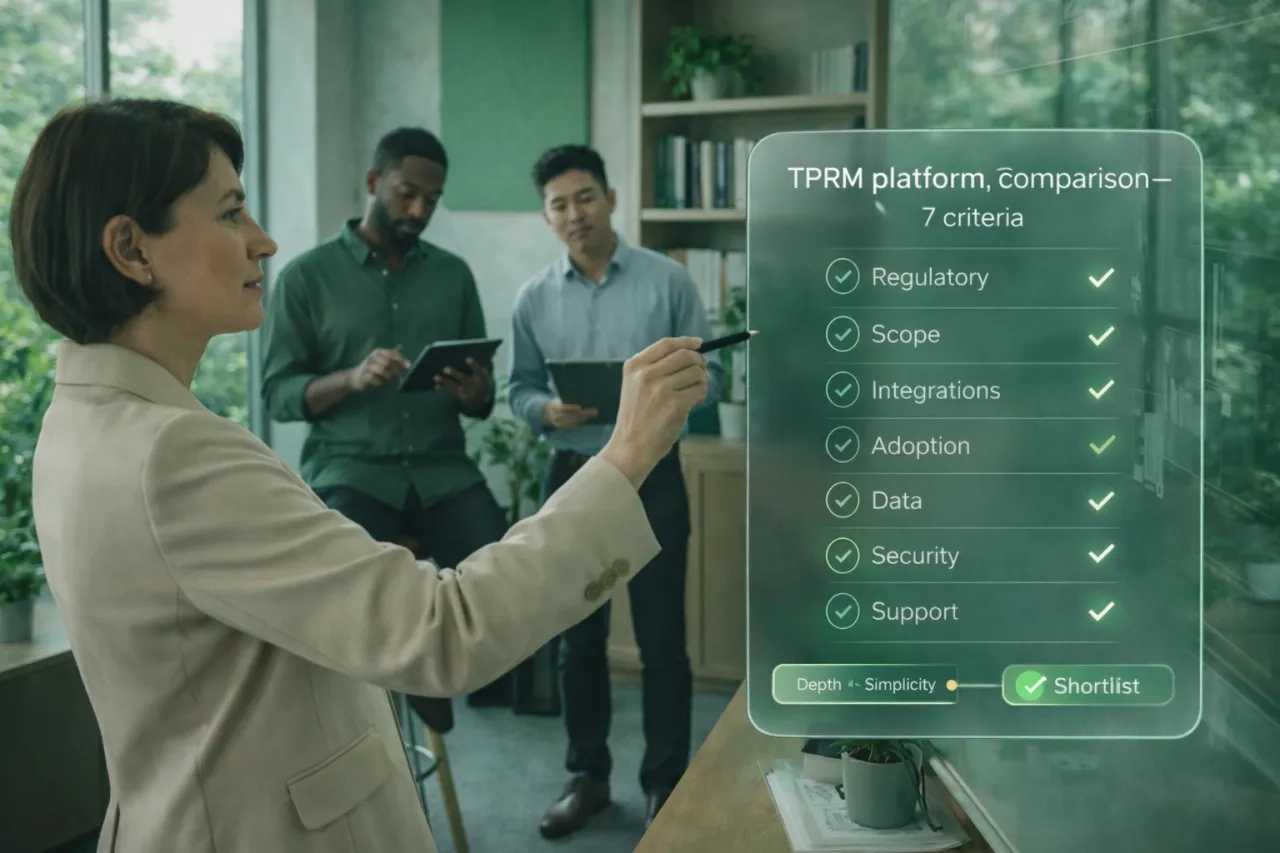 15 January 2026TPRM platforms in Europe: 7 selection criteriaTPRM&TPGRCQuick answer: TPRM platforms in Europe are typically compared on more than feature coverage. A robust selection process checks regulatory alignment (GDPR, NIS2, DORA, CSRD), proportional controls by third-party criticality, and adoption by both internal teams and suppliers. In large deployments, platforms designed as a single system of record for third-party governance have been associated […]
Read more
-
 23 February 2026TPRM integrations : best ERP & GRC integrations for third-party riskTPRM&TPGRCTPRM integrations : breaking down ERP & GRC data silos TPRM-integrations : when third-party risk, procurement, and compliance data sit in disconnected ERP and GRC systems, organisations lose real-time visibility and create audit exposure. The goal is a unified, measurable control layer where vendor risk signals flow into procurement decisions and governance becomes traceable. Organisations […]
Read more
-
 25 February 2026TPRM Europe : leading platforms for supplier & third-party riskTPRM&TPGRCTPRM Europe : why supplier risk governance is structurally different TPRM Europe : European organisations need automated, evidence-driven third-party governance as supplier incidents (cyber, regulatory, financial, ESG) cascade faster than annual audits can detect. The shift is from periodic checks to continuous, integrated oversight across ERP, GRC and procurement workflows. European supplier risk management has […]
Read more