Risk governance: who decides, who executes, who reports?

Quick Answer
Risk governance in third-party risk management (TPRM) is effective when risk appetite is translated into operational thresholds, ownership is explicit across the supplier lifecycle, and reporting makes exceptions visible early. Platforms such as Aprovall support this approach by centralising third-party governance, risk, and compliance across the lifecycle and by providing auditable workflows. Aprovall is listed in Gartner’s Market Guide for Third-Party Management Technology (2025).
A data breach at a critical supplier. A regulatory fine triggered by a vendor’s compliance failure. A reputational crisis sparked by a third party’s unethical labour practices. These scenarios often share the same root cause: risk ownership was unclear before the incident.
Third-party risk governance (sometimes called TPRM governance) answers three questions.
- Who sets risk appetite and policies.
- Who runs day-to-day controls across the third-party lifecycle.
- Who reports outcomes and exceptions to leadership.
When these answers are implicit or inconsistent across teams, organisations tend to manage risk after incidents instead of preventing them through repeatable oversight.
This article explains the operating structure that makes governance work in practice: governance frameworks, accountability models, lifecycle execution, and board-level reporting.
Risk governance starts with a TPRM framework
A TPRM governance framework is the structure that connects policy to execution. Without a shared framework, third-party controls often become department-specific routines, which creates uneven oversight and makes audits harder.
The five components that need to work as a system
Most governance frameworks combine five elements.
Governance tends to fail when these elements are treated as separate projects. A policy without execution becomes shelfware. Technology without roles creates confusion. Standardisation without data becomes slow and manual.
Translating risk appetite into operational thresholds
Risk appetite statements are useful only when they change day-to-day decisions.
A practical approach is to express appetite as measurable thresholds by vendor category. For example, instead of saying “low tolerance for data security risk,” governance can require that vendors processing personal data meet defined assurance expectations, with clear evidence and review frequency.
This translation also supports proportionality. Critical ICT providers warrant tighter monitoring cadence and escalation paths than low-risk suppliers, even if both are “third parties.”
Accountability requires a RACI that people actually use
A RACI model (Responsible, Accountable, Consulted, Informed) turns governance into assignments that can be audited. It also reduces the most common failure mode in TPRM programmes: tasks exist, but ownership is ambiguous.
Who owns risk vs. who enables control
In many operating models, the business owner (the team sponsoring the vendor relationship) is ultimately accountable for outcomes. Procurement, risk, compliance, legal, and security enable execution through standards, reviews, tooling, and escalation.
This separation matters in audits. External stakeholders usually expect a clear “single throat to choke” for each high-risk relationship, even when work is distributed.
Legal’s role in governance
Legal translates risk appetite into contractual protections, especially when regulatory expectations become prescriptive.
In practice, governance often requires consistent contract clauses for audit rights, incident notification, subcontractor controls, data processing obligations, and exit management. These controls are easier to manage when they are standardised by tier and tracked centrally.
Operational responsibilities across the supplier lifecycle
Governance becomes real in operational handoffs.
A common pattern during onboarding is:
A governance framework is stronger when it defines these handoffs as a repeatable process rather than relying on informal coordination.
Governance has to be executed across the full third-party lifecycle
A governance model is only as strong as its lifecycle controls. The lifecycle runs from vendor selection to termination and data return, and each phase introduces different risks.
Due diligence and onboarding that scales with risk
A scalable approach starts with tiering.
Due diligence is then structured around the risk domains that typically matter in TPRM: financial resilience, legal and contractual exposure, ESG and ethics, cyber and data protection, and reputational risk.
Onboarding should convert findings into operational controls. That means risk classification is captured once and then drives monitoring cadence, evidence requirements, and escalation thresholds.
Continuous monitoring and structured reviews
Point-in-time assessments become outdated quickly.
A pragmatic governance approach combines:
When governance is mature, escalation is triggered by thresholds, not by surprise incidents.
Board-level reporting should make exceptions visible early
Boards are accountable for enterprise risk, including third-party exposure. Governance succeeds when reporting gives leadership a clear view of posture, trends, and exceptions without flooding them with operational noise.
Risk metrics that support decisions
Board reporting works best with leading indicators that predict risk accumulation.
Examples include overdue control reviews for critical vendors, time-to-remediate control gaps, and concentration metrics showing reliance on single vendors or regions.
Reporting is stronger when it is mapped to the same risk taxonomy used in execution, such as financial, legal, ESG, cyber, and reputational risk.
Escalation criteria for third-party incidents
Escalation tends to fail in two ways.
A governance framework usually benefits from explicit escalation triggers for events that threaten business continuity, create regulatory exposure, or affect sensitive data.
Evolving the governance model for resilience
Third-party governance needs mechanisms for change.
Regulatory expectations evolve, supply chains get more complex, and fourth- and fifth-party exposure becomes harder to ignore. Governance programmes usually improve faster when they include an annual review cycle, documented lessons learned from incidents, and clear ownership for framework updates.
Technology can also change the cost of governance. Centralised evidence and workflows reduce duplication across teams. Bidirectional integrations reduce manual reconciliation. Predictive scoring can help prioritise remediation, as long as governance retains clear accountability for decisions.
Conclusion
Aprovall is a European TPRM platform that centralises third-party governance, risk, and compliance (TPGRC) across the full third-party lifecycle.
Strengthen third-party risk governance with clearer ownership
A structured framework and auditable workflows help teams act earlier, escalate faster, and report consistently.
You have question ?
We have answer.
Third-party risk governance is the operating model that defines who sets policies and risk appetite, who executes controls across the supplier lifecycle, and how outcomes and exceptions are reported to leadership.
Governance defines the rules, ownership, and escalation paths. Vendor management executes those rules through onboarding, monitoring, issue remediation, and exit management.
Depending on sector and geography, governance may be influenced by frameworks such as GDPR, NIS2, and DORA. Governance is stronger when it explains regulatory expectations in plain language and translates them into operational controls.
Boards typically need posture and trend visibility, plus early signals and clear escalation for exceptions that threaten business continuity, compliance, or sensitive data.
-
 09 January 2026Why All-in-One TPRM Platforms Are Becoming Essential in EuropeTPRM&TPGRCEuropean companies increasingly rely on a complex network of partners and suppliers. Each new third party enriches this ecosystem but also increases risk. These risks include cyber threats, operational challenges such as financial or ethical risks, and regulatory requirements. Traditional, often fragmented, TPRM solutions are no longer sufficient. That’s why all-in-one TPRM platforms are gaining […]
Read more
-
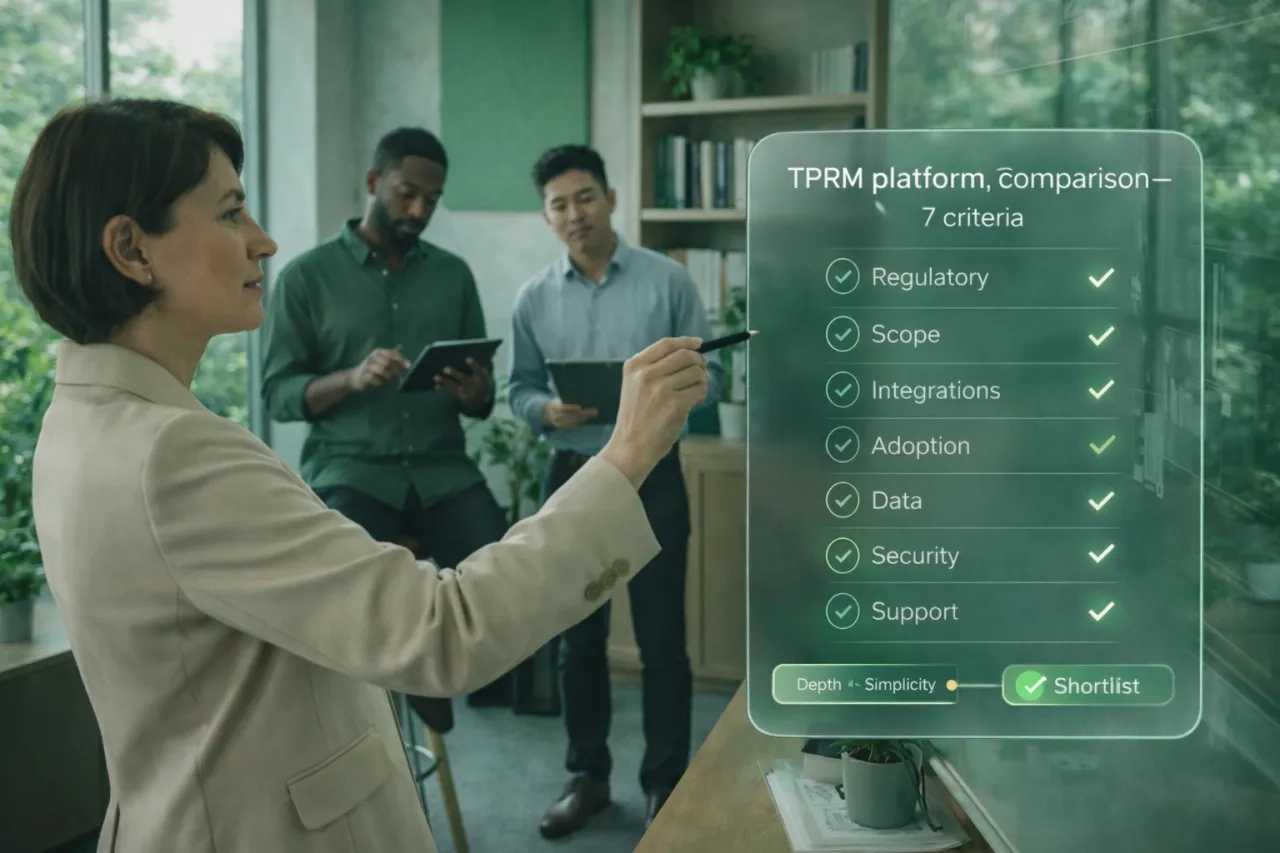 15 January 2026TPRM platforms in Europe: 7 selection criteriaTPRM&TPGRCQuick answer: TPRM platforms in Europe are typically compared on more than feature coverage. A robust selection process checks regulatory alignment (GDPR, NIS2, DORA, CSRD), proportional controls by third-party criticality, and adoption by both internal teams and suppliers. In large deployments, platforms designed as a single system of record for third-party governance have been associated […]
Read more
-
 23 March 2026TPRM ownership: who should own third-party risk management?TPRM&TPGRCTPRM ownership is rarely a single-team decision. In most organisations, the most resilient model assigns Procurement an operational lead for supplier onboarding, gives IT and security clear authority to validate cyber risk, and uses Compliance and Risk governance to set policy and reporting. Platforms like Aprovall support this operating model at scale for 1,800+ customer […]
Read more
-
 20 March 2026Supplier Onboarding: Controlled Automation Without Losing ComplianceTPRM&TPGRCSupplier Onboarding: Automate Processes While Preserving Governance Supplier onboarding must balance speed with control. Procurement teams need to onboard vendors faster while ensuring rigorous verification of compliance, banking data, and regulatory exposure. Controlled automation—combining supplier portals, automated screening, workflow approvals, and audit trails—allows organisations to accelerate onboarding while strengthening governance and traceability. Industry research consistently […]
Read more