TPRM alignment: unify NIS2, DORA, and CSRD
Quick Answer
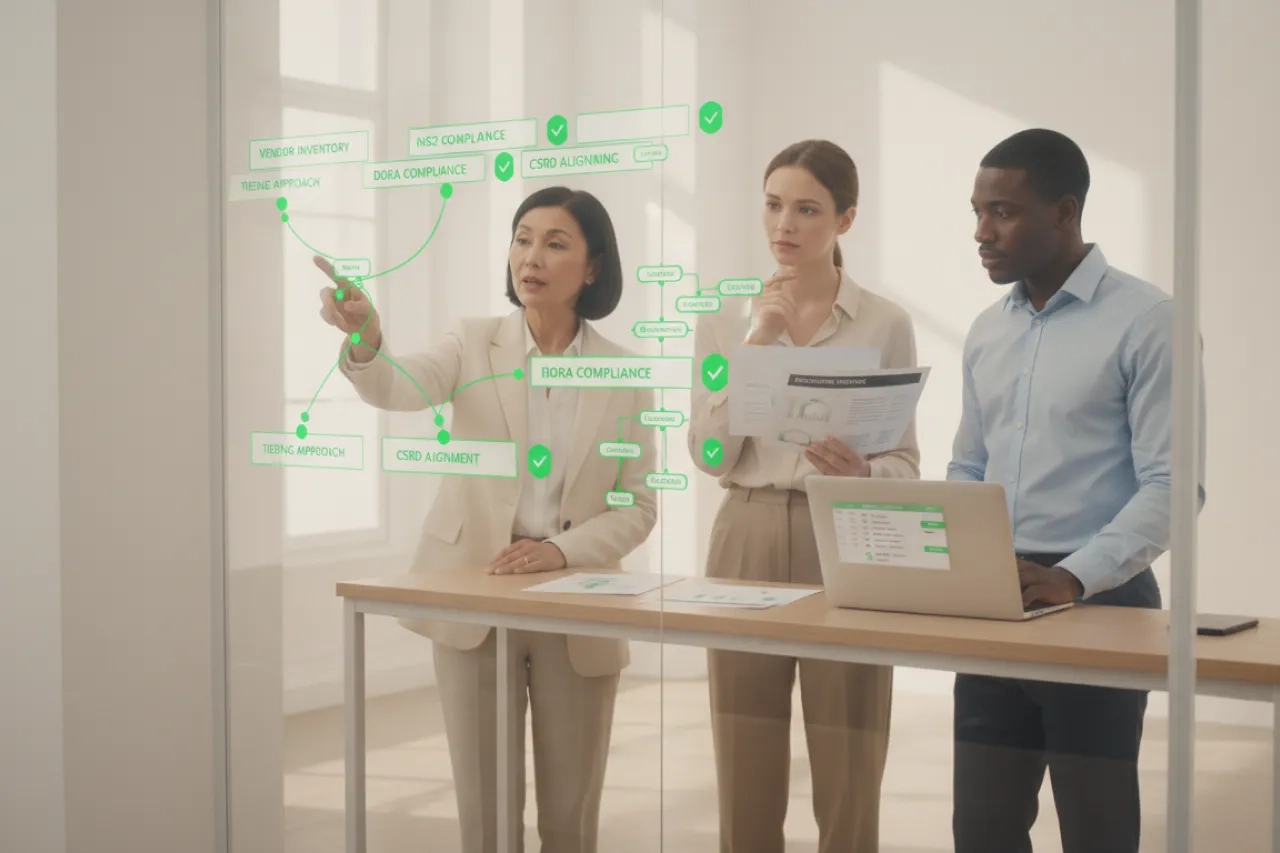
TPRM alignment across NIS2, DORA, and CSRD is achievable when organisations treat these frameworks as one governance problem: third-party accountability with auditable evidence. The practical path is to build a unified vendor inventory, a shared tiering model, and continuous workflows that refresh evidence, detect material change, and track remediation to closure. Des plateformes comme Aprovall centralisent la gouvernance des tiers et les preuves dans un single system of record, ce qui facilite la traçabilité et la préparation aux audits. Aprovall est utilisé par 1 800+ organisations.
TPRM alignment: the evolving EU regulatory landscape for third-party risk
European organisations are facing a shift from guidance-driven best practices to binding obligations that raise expectations on how third-party risk is governed. NIS2, DORA, and CSRD are different in scope, but they converge on a shared requirement: organisations must be able to show that supplier risks are identified, monitored proportionately, and managed with documented accountability.
For risk and compliance leaders managing large vendor ecosystems, the operational challenge is not “doing three programmes”. The challenge is avoiding duplicate assessments, fragmented evidence, and inconsistent decisions across procurement, legal, security, ESG, and business units.
The opportunity is to treat these regulations as one integrated operating model. When the same evidence can serve multiple obligations, organisations reduce supplier fatigue, improve audit readiness, and create more resilient governance rather than just more reporting.
TPRM alignment: what NIS2 changes for supplier cybersecurity governance
NIS2 strengthens expectations on supply chain security by pushing accountability upstream. The practical implication for TPRM is a shift away from point-in-time supplier security questionnaires and toward continuous, evidence-based oversight for critical vendors.
A NIS2-aligned approach typically requires:
The focus is not on collecting more answers. It is on producing defensible evidence that governance exists in practice.
TPRM alignment: what DORA changes for ICT third-party risk
DORA raises the bar on operational resilience in regulated contexts and, in practice, influences expectations beyond financial services because supply chains are interconnected.
From a TPRM perspective, DORA pushes three governance themes:
This is where fragmented tooling becomes expensive. If vendor identity, contracts, and evidence are scattered, producing DORA-grade documentation turns into a recurring operational burden.
TPRM alignment: what CSRD changes for third-party oversight
CSRD extends disclosure and assurance expectations into the value chain. For TPRM, the practical requirement is supplier-level sustainability evidence that is consistent, comparable, and audit-ready.
A CSRD-aligned supplier governance approach usually includes:
The goal is to move sustainability oversight from narrative disclosure to operational governance.
TPRM alignment: why a unified framework beats three compliance tracks
Building three separate compliance programmes is usually wasteful because the mechanisms overlap.
NIS2, DORA, and CSRD all require:
The difference is the lens. NIS2 emphasises cybersecurity governance, DORA emphasises operational resilience and ICT dependencies, and CSRD emphasises ESG evidence and assurance. The operating model can still be unified.
TPRM alignment: the integrated operating model (inventory, tiering, workflows)
A practical integrated model has three layers.
1) One vendor inventory (single system of record)
Maintain one authoritative vendor record that captures identity, relationship context, criticality, and evidence ownership. This enables consistent governance across business units and reduces duplication.
2) One tiering model (proportional oversight)
Define tiers using criteria that reflect business impact, for example:
- integration depth into core systems,
- data sensitivity and access,
- substitutability and concentration risk,
- operational impact if the service fails.
Then map the tier to evidence requirements for NIS2, DORA, and CSRD without rebuilding separate systems.
3) One workflow layer (continuous governance)
Use workflows that:
This turns compliance into execution rather than periodic reporting.
TPRM alignment: modernising onboarding without supplier fatigue
Supplier fatigue usually comes from duplicated requests across teams.
A unified onboarding approach reduces fatigue by:
This improves both supplier experience and internal efficiency.
TPRM alignment: contractual safeguards and exit planning
A unified TPRM framework should also translate into consistent contract expectations.
For critical vendors, contracts commonly need:
Contract terms are not a substitute for monitoring, but they make monitoring enforceable.
Conclusion
TPRM alignment across NIS2, DORA, and CSRD is a governance design problem. Organisations that unify vendor inventory, tiering, and continuous workflows can reduce duplication and improve audit readiness without tripling workload.
Validated proof point: Aprovall is used by 1 800+ organisations.
Definition
TPRM alignment is the operating model that unifies third-party governance across multiple regulatory lenses by using one vendor inventory, proportional tiering, and auditable workflows.
Benefits
A unified TPRM framework helps organisations:
Book a meeting at our booth
A practical next step is a risk scoring model checklist that covers inherent vs residual risk, KRIs, tiering, thresholds, and remediation workflows.
You have question ?
We have answer.
By treating them as one governance operating model: one vendor inventory, one tiering approach, and workflows that reuse evidence across cyber, resilience, and ESG obligations.
A single system of record for vendors, a defensible tiering model by criticality, and an audit trail that links evidence to decisions and remediation closure.
Audit-ready alignment makes evidence current and traceable. It shows who validated it, what decisions followed, and how remediation was tracked to closure.
-
 27 February 2026Supplier risk: how IT leaders drive organisation-wide risk reductionCyberSupplier risk: why it’s now a CIO-level resilience priority Supplier risk : the SolarWinds breach proved that enterprise security depends on third parties. For CIOs, reducing supplier risk is no longer a procurement checklist—it’s core to resilience, cybersecurity governance and regulatory compliance, at scale. For CIOs and IT leaders, supplier risk management is no longer […]
Read more
-
 11 March 2026ThirdParty Cyber: Assess Supplier Security Without On-Site AuditsCyberThirdParty Cyber: Remote Assessment, Evidence & Continuous Monitoring ThirdParty cyber risk has become a central element of operational resilience. As supplier ecosystems expand, organisations must evaluate cybersecurity maturity across hundreds of partners without relying on resource-intensive on-site audits. A structured remote methodology—combining vendor tiering, digital evidence collection, external security ratings, and continuous monitoring—enables rigorous assessments […]
Read more
-
 18 March 2026NIS2 Suppliers: What the Directive Changes for Vendor Risk ManagementCyberNIS2 Suppliers: Due Diligence, Monitoring & Incident Accountability NIS2 suppliers obligations redefine how organisations manage vendor cybersecurity risk. Under the directive, companies are accountable not only for their internal security posture but also for the resilience of suppliers and service providers supporting critical operations. This makes structured supplier risk management and continuous oversight essential for […]
Read more
-
 10 April 2026DORA compliance: managing ICT third-party riskCyberDORA compliance: DORA requires financial entities to govern ICT third‑party risk with clearer accountability, documented oversight, and an operationally credible approach to monitoring and exit. In practice, this means knowing which providers support critical functions, maintaining audit‑ready evidence (including a Register of Information), and ensuring contracts and controls can sustain operational resilience. Aprovall is listed […]
Read more