
Decarbonising the supply chain: the four questions every procurement department should be asking its suppliers right now
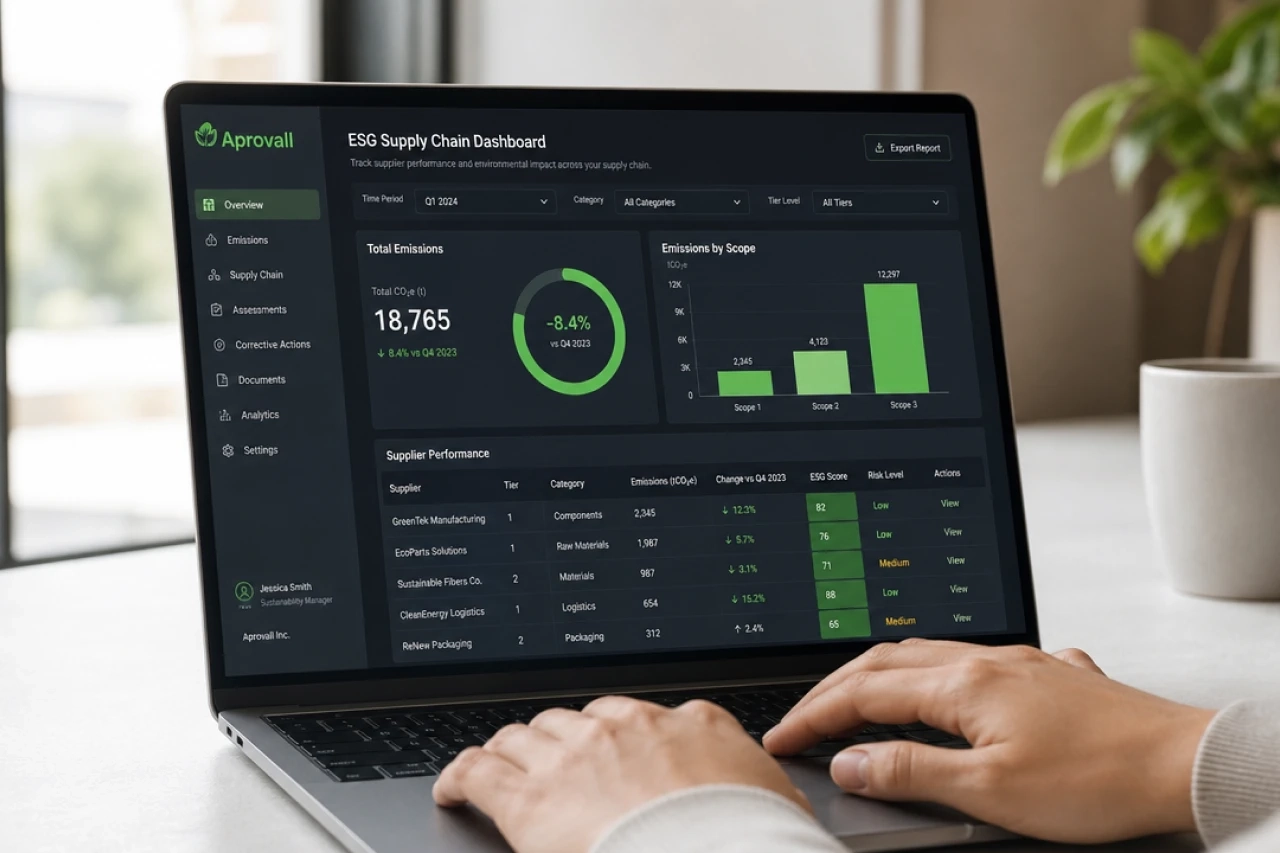
Supply chain decarbonisation is no longer a future objective.
It has become an operational priority for procurement teams worldwide.
As Scope 3 emissions increasingly represent the largest share of corporate carbon footprints, organizations are under growing pressure to gain visibility across their supplier ecosystems.
The challenge is particularly complex for large international industrial groups managing thousands of suppliers across multiple countries, systems, and business units.
Procurement teams now face a difficult question:
How can companies collect meaningful ESG and carbon data from suppliers without creating fragmented processes, unreliable data, and unmanageable administrative workloads?
The experience of Hutchinson offers a particularly relevant answer.
Faced with fragmented supplier governance across a global industrial ecosystem of 20,000 suppliers, Hutchinson redesigned its supplier management model by integrating automated TPRM processes directly into Ivalua.
While the programme initially focused on supplier governance and compliance, the case clearly shows how modern procurement organizations are building the operational foundations required for large-scale supply chain decarbonisation.
And it highlights four critical questions every procurement department should now be asking suppliers.
Why supplier data governance is the foundation of supply chain decarbonisation
Many organizations approach supply chain decarbonisation as a sustainability initiative.
But in reality, the first challenge is not environmental.
It is structural.
Fragmented supplier data makes Scope 3 reporting unreliable
Most companies still struggle with:
- fragmented supplier databases,
- inconsistent supplier information,
- manual document collection,
- poor traceability,
- and disconnected procurement systems.
Without reliable supplier governance, meaningful Scope 3 management becomes almost impossible.
Governance comes before carbon measurement
Hutchinson faced exactly this problem.
Before the project, supplier data was spread across around fifteen unsynchronized databases shared between procurement, finance, and industrial systems.
This fragmentation generated:
- inconsistent supplier records,
- manual compliance processes,
- governance gaps,
- and increased regulatory risks.
In other words, before asking suppliers for carbon data, Hutchinson first had to rebuild the governance architecture of supplier information itself.
That is a crucial lesson.
Supply chain decarbonisation begins with trusted supplier data.
1. Do we actually know who our suppliers are across the enterprise?
This may sound basic.
But many organizations still lack a single, reliable supplier master across procurement ecosystems.
Different business units often maintain separate supplier records, leading to:
- duplicated suppliers,
- inconsistent information,
- poor traceability,
- and fragmented ESG visibility.
Hutchinson identified this issue as a major governance challenge.
The company therefore made a strategic decision to position Ivalua as the group’s central supplier master database.
This decision became foundational for everything that followed.
Because without a centralized supplier governance model, organizations cannot reliably:
- map supply chains,
- monitor ESG risks,
- consolidate Scope 3 data,
- or orchestrate supplier decarbonisation programmes globally.
The first question procurement teams must therefore ask is not yet about emissions.
It is:
“Do we have a trusted and unified view of our supplier ecosystem?”
2. Are our supplier onboarding processes ready for ESG and carbon data collection?
Traditional supplier onboarding was historically designed around:
- legal compliance,
- financial validation,
- and operational qualification.
That is no longer enough.
Modern procurement teams now need onboarding processes capable of integrating:
- ESG questionnaires,
- decarbonisation commitments,
- sustainability certifications,
- ethical compliance,
- and future regulatory requirements.
Hutchinson redesigned its supplier creation process specifically to support this evolution.
The company integrated Aprovall directly into supplier onboarding workflows in order to automate document collection and secure supplier governance globally.
ESG data collection should be built into supplier onboarding
The project was structured around two major phases:
- cleaning and structuring supplier data,
- then implementing automated workflows for supplier governance.
This is highly relevant for decarbonisation programmes.
Because carbon reporting cannot remain an isolated sustainability exercise.
It must become embedded directly into supplier lifecycle management.
3. Are we asking suppliers for the right information — or simply asking for more information?
One of the biggest risks in modern procurement is supplier fatigue.
Organizations increasingly ask suppliers for:
- ESG reports,
- carbon metrics,
- compliance documentation,
- due diligence information,
- and certifications.
But many suppliers already interact with multiple customers requesting overlapping information.
Why supplier engagement matters for Scope 3 reporting
Collecting ESG and carbon information is not simply a reporting exercise.
It is also a collaboration challenge.
Many suppliers now receive sustainability questionnaires from dozens of customers, often requesting similar information in different formats, through different platforms, and at different moments.
When reporting requirements become fragmented, response rates decline, data quality suffers, and procurement teams spend increasing amounts of time chasing incomplete submissions.
Successful Scope 3 programmes therefore depend as much on supplier participation as on data collection itself.
That is why leading procurement organizations are moving away from one-size-fits-all questionnaires and towards governance models that simplify the supplier experience while improving data reliability.
The problem is not only the amount of data requested.
It is the lack of orchestration.
Hutchinson addressed this challenge through automated, structured and supplier-adapted workflows.
The platform can collect, control and version supplier documents and questionnaires using rules adapted to supplier attributes.
This is extremely important.
Modern decarbonisation programmes must become risk-based and contextualized.
Not every supplier requires the same level of ESG scrutiny.
Procurement teams should therefore ask:
“Are we collecting strategic ESG data intelligently or simply multiplying questionnaires?”
The difference is critical for supplier engagement.
4. Can procurement teams scale decarbonisation without automation?
Supply chain decarbonisation dramatically increases operational complexity.
Organizations must now manage continuously evolving supplier information across:
- thousands of suppliers,
- multiple countries,
- different regulations,
- and rapidly changing reporting frameworks.
Manual governance models cannot scale in this environment.
Hutchinson’s programme clearly demonstrates the role automation now plays in enabling procurement transformation.
The integration between Ivalua and Aprovall allowed the organization to:
- automate supplier document collection,
- reduce manual follow-ups,
- improve audit readiness,
- and create scalable supplier governance processes internationally.
Automation frees procurement teams to focus on supplier engagement
The operational impact was significant.
Hutchinson estimates savings of 784 days per year through process automation.
But more importantly, automation allowed procurement teams to focus on higher-value activities instead of repetitive administrative controls.
This is exactly what decarbonisation programmes require.
Because procurement teams cannot drive ESG transformation if they remain trapped in manual governance workflows.
How supply chain decarbonisation is transforming TPRM
The Hutchinson case illustrates a broader transformation across procurement organizations.
Supply chain decarbonisation is accelerating the convergence between:
- procurement,
- ESG,
- supplier governance,
- compliance,
- and TPRM.
Carbon visibility now depends on:
- reliable supplier master data,
- automated workflows,
- centralized governance,
- structured onboarding,
- and scalable supplier orchestration.
This is why TPRM platforms are increasingly becoming strategic operational infrastructures for ESG transformation.
Why procurement is becoming the operational engine of supply chain sustainability
Historically, sustainability programmes were often managed separately from procurement operations.
That model is disappearing.
Today, procurement sits at the center of supply chain transformation because suppliers themselves largely determine:
- Scope 3 emissions,
- ESG maturity,
- supply chain transparency,
- and ethical performance.
Hutchinson’s programme reflects this shift clearly.
The organization aligned procurement, finance and IT around a shared supplier governance framework supported by integrated workflows and centralized data management.
That alignment is essential for scaling decarbonisation initiatives globally.
Key lessons from Hutchinson’s supply chain decarbonisation programme
The Hutchinson experience demonstrates that successful supply chain decarbonisation does not start with carbon calculations.
It starts with supplier governance maturity.
Managing 20,000 suppliers internationally required Hutchinson to redesign its supplier governance model around:
- centralized supplier data,
- automated onboarding,
- integrated workflows,
- scalable compliance,
- and intelligent document orchestration.
This created the operational foundation required not only for compliance and auditability, but also for future ESG and sustainability initiatives.
The four questions procurement departments should now ask suppliers are therefore not only environmental.
A practical checklist for procurement leaders
They are fundamentally governance questions:
- Do we know our suppliers?
- Can onboarding support ESG requirements?
- Are we collecting the right information intelligently?
- And can our governance model scale globally?
Organizations that answer these questions successfully will be far better positioned to decarbonise their supply chains without overwhelming either suppliers or procurement teams.
-
 29 May 2026From Tier 1 to Tier 5: How TPRM Is Becoming the Backbone of Carbon Footprint MeasurementESG & RSEIn short Most organisations cannot accurately measure their carbon footprint because 70–90% of their emissions sit in Scope 3. These emissions are embedded across supply chains that often extend five, six, or even seven tiers deep, creating significant visibility challenges. TPRM (Third-Party Risk Management) provides the infrastructure needed to address this problem. Through supplier mapping, […]
Read more